Local presence dialing: how it works, when it helps, and when it backfires
Adoptiv Team··4 min read
Short answer
Local presence dialing shows a caller ID with the same area code as the person you're calling, using phone numbers you own in those areas. People answer familiar area codes more often. It backfires when a few numbers carry too many calls and get flagged as spam, so spread calls across enough numbers, warm new ones up, and favor numbers each contact has answered before.
Look at your own phone's recent calls. You probably answered the ones from your area code and let the rest ring. Your leads do the same, which is why outbound teams buy local numbers. Done well, it's one of the simplest ways to get more people to pick up. Done badly, it's one of the fastest ways to get a pool of numbers labeled "Spam Likely".
How local presence dialing works
You own phone numbers in the area codes you call most.
Before each call, the dialer picks one of your numbers to show, usually one whose area code matches the contact's.
If they call back, the number rings your team, because it's a real line you own.
That last step matters. A local number that doesn't ring back, or goes to a dead voicemail, makes your company look like a robocaller. Every number you show should reach a person or a proper voicemail.
One number vs local presence vs smart caller ID
One number for everyone
Local presence
Smart caller ID
What it picks
The same number every call
A number matching the contact's area code
The number this contact is most likely to answer
Uses contact history
No
Usually not
Yes
Spam risk
High at volume
Medium; depends on volume per number
Lower, if paired with health checks
Numbers needed
One
One or more per area code you call
A pool, ideally local
When local presence helps
You call consumers or small businesses across many area codes. Insurance, solar, real estate and home services all fit.
Your leads don't know you yet. A familiar area code is the only trust signal on the screen.
You expect callbacks. A local number that rings your team turns missed calls into inbound ones.
Try it on your own numbers. Adoptiv puts the dialer, the phone system and the CRM in one tool. Fourteen days free, with the AI switched on.
Too few numbers, too many calls. One local number carrying a whole team's dials looks like a robocaller to carrier analytics. That's the classic route to a spam label. See how to remove "Spam Likely" if it's already happened.
Brand-new numbers at full volume. A number with no history that suddenly makes hundreds of calls gets flagged quickly. Start each number on a few calls a day and build up over a week.
Cycling through numbers. Buying fresh numbers to replace flagged ones, again and again, is a pattern carriers watch for.
Calling from numbers you don't own. Showing a number you don't have the right to use is spoofing. Only use numbers you've bought and can answer.
Assuming the area code means where they live. People keep their numbers when they move. A Seattle area code on a Florida resident still gets a Seattle caller ID, which is fine for answer rates but no help with calling hours. Work out local time from the address too.
Set it up properly
Find your top area codes. Count your contacts by area code and buy numbers for the ones that matter most.
Size the pool. Spread calls so no number carries a heavy daily load. There's no published safe limit; a common rule of thumb is under 50 to 100 outbound calls per number a day.
Register every number. Submit them to the Free Caller Registry and set up your business name (CNAM).
Rest numbers that look flagged instead of pushing through.
How Adoptiv picks the number
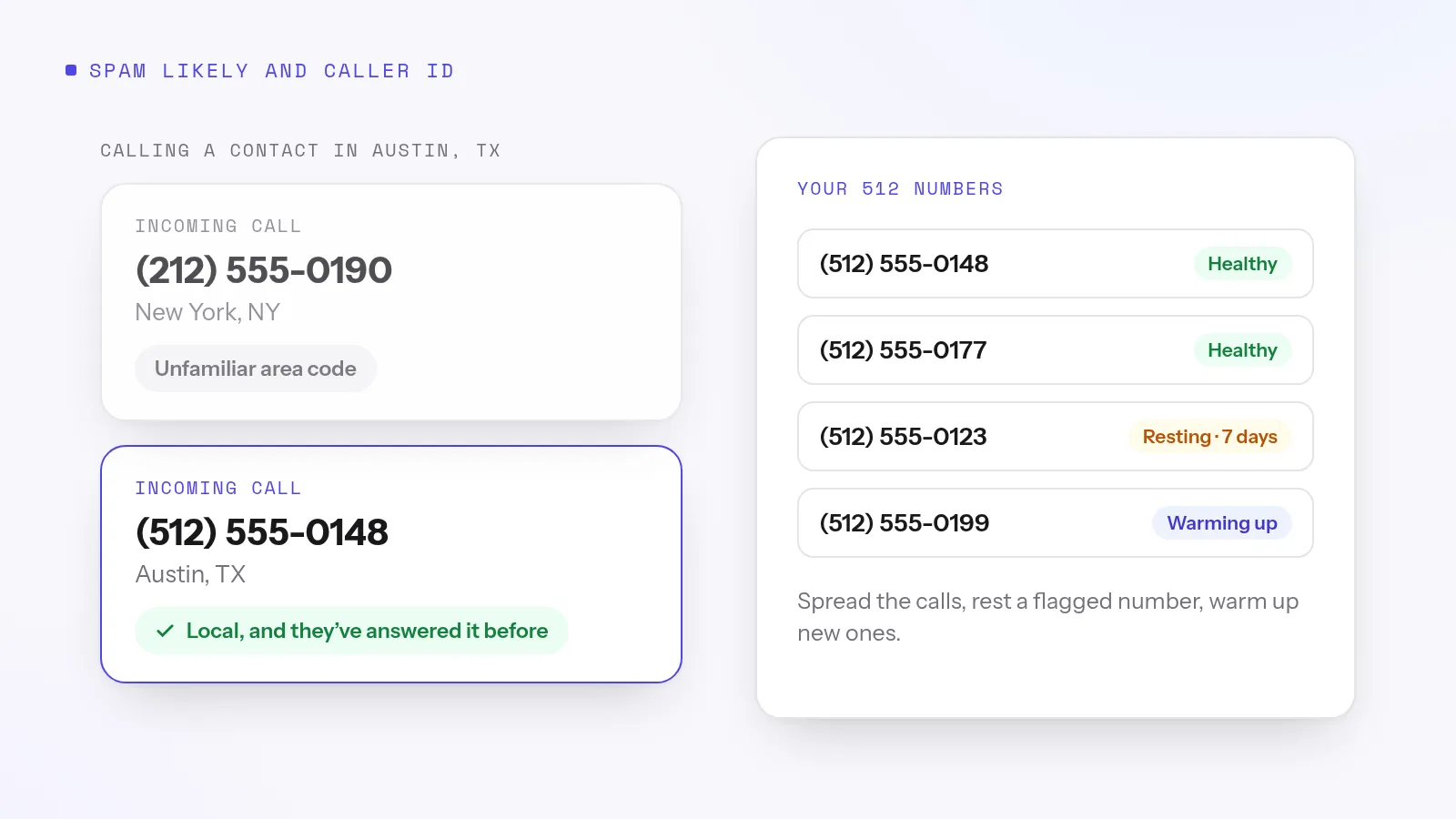
Adoptiv's smart caller ID treats local presence as one signal, not the whole rule. Before each call it scores every number the rep may use against the contact. Half the score is whether this person has answered that number before, 30% is the number's own answer rate, and 20% is how recently it was used. A number whose prefix matches the contact's gets 10 extra points, and one that has never reached a known contact loses 20. The top number is pre-selected and the rep can pick another in one tap.
Behind that, caller ID reputation gives every number a daily 0 to 100 health score. A number that looks flagged rests for seven days while a clean spare takes its calls, and new numbers warm up over a week. You can buy local numbers by area code in seconds, and Dialer Plus includes 25 caller IDs per rep.
Common questions
What is local presence dialing?+
Calling each contact from one of your own phone numbers with their local area code, so the call looks familiar and is more likely to be answered.
Does local presence dialing work?+
It usually raises answer rates, because people answer familiar area codes more often. It stops working if your local numbers get flagged as spam from carrying too many calls.
Is local presence dialing legal?+
Using numbers you own and can answer is standard practice. Showing numbers you don't own is spoofing. Ask your counsel about the rules for your calls.
How many local numbers do I need?+
Enough that no number carries a heavy daily load in each area code you call. Start with your busiest area codes and add numbers as volume grows.
Adoptiv is the dialer, the CRM and the AI on one platform, where the busywork logs itself and your reps just talk. Try it free for 14 days, with no credit card.
Questions? Call +1 (844) 955-7733. SIYA answers and puts you through to a person.