
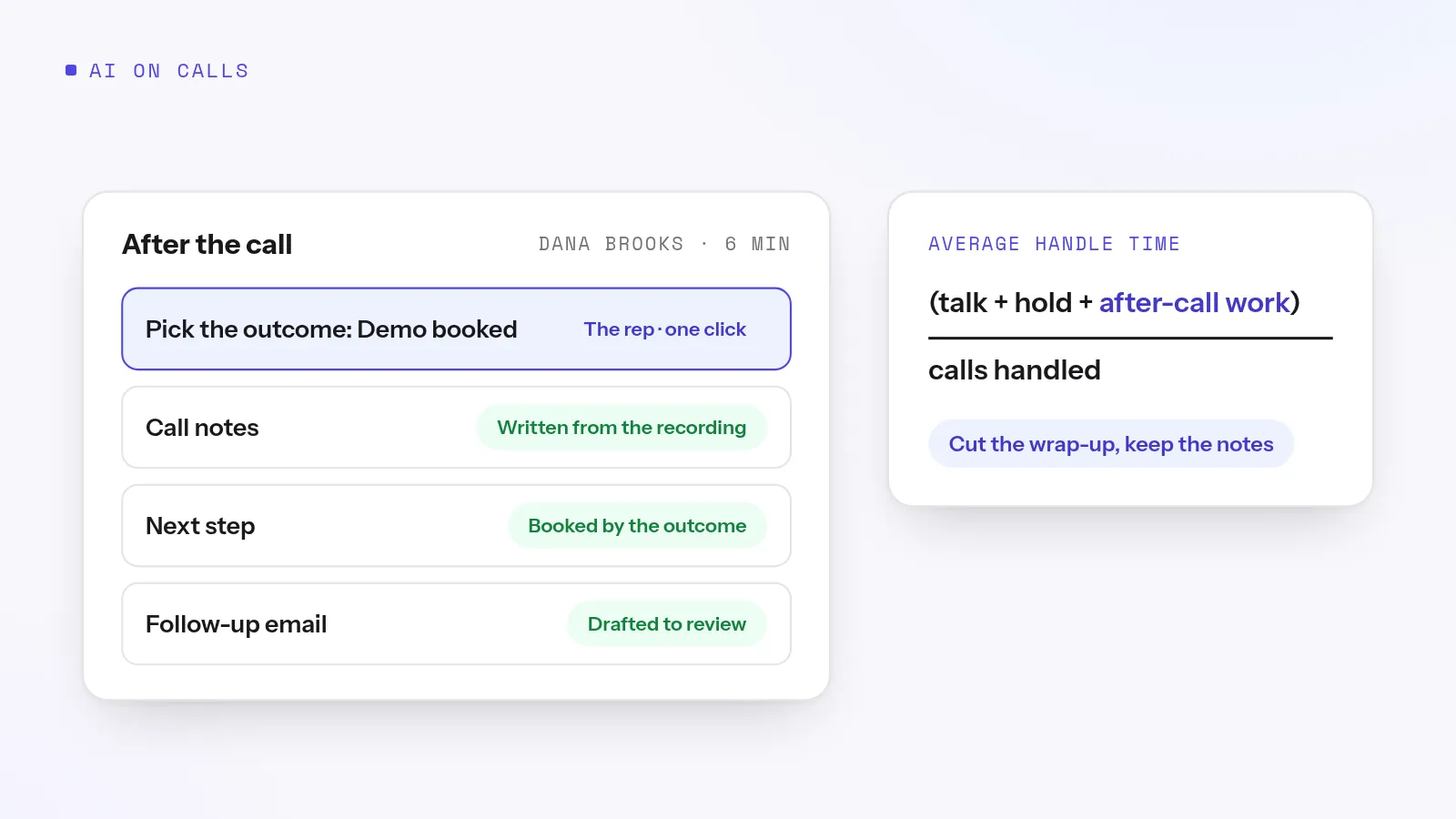
After-call work, or ACW, is the hidden half of a phone job. Ask a rep how long they spend after each call and they'll guess a few seconds. Time it and it's often a minute or two: finding the record, typing a note, setting a callback, writing the email they promised. Across 60 calls a day, that's an hour or more.
Measure it first
| Measure | How to work it out |
|---|---|
Average after-call work | Total wrap-up time ÷ calls handled |
Average handle time (AHT) | (Talk time + hold time + after-call work) ÷ calls handled |
ACW share of handle time | After-call work ÷ average handle time |
Follow-up completion | Promised follow-ups actually done ÷ promised |
Watch the last line as closely as the first. Cutting wrap-up time while follow-ups slip is a false saving.
Six ways to reduce after-call work
1. Have the outcome do the follow-up
The rep has to pick how the call went anyway. Make that one click do the rest: "Callback requested" books the callback, "Not interested" closes the lead, "Do not call" marks the number. Keep the list short, and see our call disposition codes post for ready-made sets.
2. Stop typing call notes
A recorded, transcribed call can be summarized automatically: why they called, what was covered and what happens next. The rep reads it and corrects it only if needed.
3. Catch promises on the call
"I'll call you Thursday" is the follow-up most likely to be forgotten. Software that spots callbacks and meetings in the conversation and suggests them as tasks closes that gap.
4. Draft the follow-up email for them
The "as promised, here's the info" email is a big part of wrap-up for many sales teams. A draft written from the conversation, which the rep checks and sends, takes seconds instead of minutes.
5. Have the record open before the call
A lot of wrap-up is really searching: finding the contact to write on. If the record opens when the call connects, that time disappears.
6. Fix the fields nobody uses
Every required field a rep fills in after a call should be read by someone. If nobody reports on it, make it optional or remove it.