There's no single best hour. For business buyers, the edges of the workday (early morning and late afternoon) and the middle of the week are the usual starting points; for consumers, early evening and weekend mornings often work. Treat those as guesses to test. The best time to make cold calls for your team is the one your own answer and conversation rates show, measured in each lead's local time and kept inside calling-hours rules.
Every sales blog has a chart of the "best" hour to call. This post is part of our guide to outbound dialers, and it takes a different view: published studies describe someone else's list. Your list, your offer and your buyers' schedules decide when people pick up.
Common starting points to test
Use these as a first schedule, not as rules. Each one comes from the same logic: call when the person is reachable and not in the middle of the thing they're paid to do.
Who you call
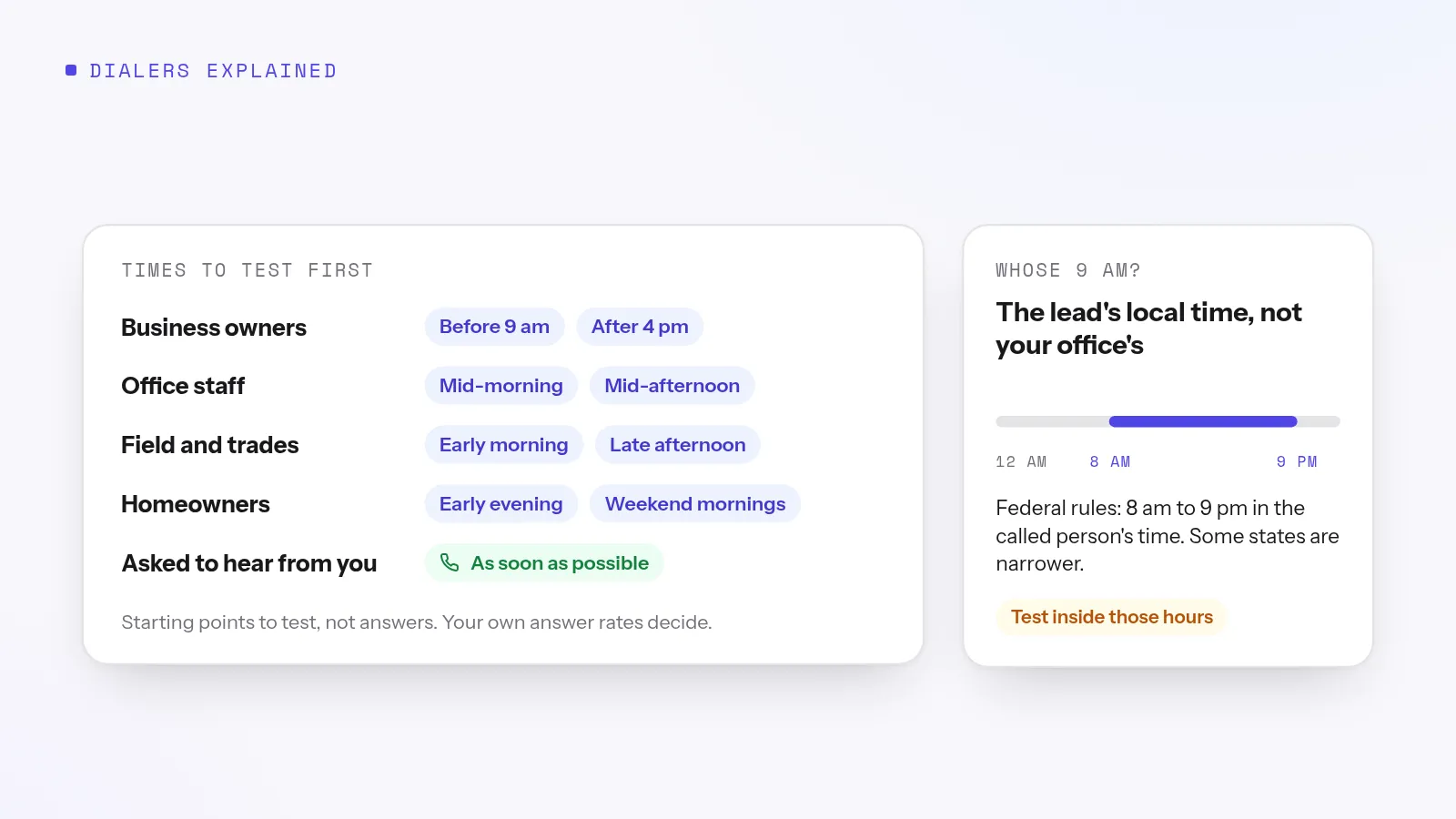
Times to test first
Why
Business owners
Before 9 am, after 4 pm
Before and after customers take their day
Office managers and staff
Mid-morning, mid-afternoon
Settled in, not yet in back-to-back meetings
Field and trade businesses
Early morning, late afternoon
Out on jobs in the middle of the day
Homeowners and consumers
Early evening, weekend mornings
At home and off work
Leads who asked to hear from you
As soon as possible
Interest fades within minutes, not days
Days matter less than hours for most lists, but Monday mornings and Friday afternoons are often weaker for business calls. Test them rather than skipping them outright.
Why your own data beats any study
A study's "best hour" mixes industries, time zones and list quality. Your numbers don't. Track two rates by hour of the lead's day: how often a call is answered, and how often an answer turns into a real conversation. Our post on contact rate vs connect rate explains the difference. An hour with fewer answers but more conversations can be worth more than a busy one.
Give each time slot a fair sample: a few hundred dials, spread over different weeks, before you decide. Then shift more of your calling into the hours that win, and keep a small share of calls in the others so you notice when a pattern changes.
Power and predictive campaigns hold leads outside local hours; preview asks for a reason. Campaigns are in early access.
Time zones and calling hours
"9 am" means nothing until you say whose 9 am. Always schedule by the lead's local time, not your office's. A national list called from one time zone will hit some leads too early and others after dinner.
Calling hours aren't only good manners. Federal rules limit telemarketing calls to between 8 am and 9 pm in the called person's local time, and several states set narrower hours or a cap on calls per day. Build those limits into your schedule first, then test inside them. This is general information, not legal advice, so check with your own counsel.
How many calls, and how far apart
Timing and persistence work together. A lead who didn't answer at 10 am may pick up at 5 pm, so spread attempts across different times of day rather than calling at the same hour each time. Our guide on how many times to call a lead covers the attempt count, and cold calls per hour covers how much a rep can fit into the hours that work best.
Testing call times in Adoptiv
By default, Adoptiv campaigns call each lead only between 8 am and 9 pm in its own local time, worked out from its address and area code, plus its state's stricter rules and your campaign's own hours. Power and predictive campaigns hold a lead outside those hours; a preview campaign shows it to the rep with a warning, and the rep can call only after giving a reason. Calls also run alongside each lead's compliance screening.
Preview dialing is on every plan, and power and predictive come with Dialer Plus and Enterprise. Campaigns are in early access, so ask us to turn them on.
Common questions
What is the best time to make cold calls?+
There's no universal hour. Start with the edges of the workday for business buyers and early evening for consumers, then let your own answer and conversation rates decide.
What is the best day to cold call?+
Midweek is a common starting point for business calls, with Monday mornings and Friday afternoons often weaker. Test every day before you drop one.
What hours are you allowed to cold call?+
Federal rules allow telemarketing calls between 8 am and 9 pm in the called person's local time, and some states are stricter. Ask your counsel which rules apply to your calls.
Should I call at the same time every day?+
No. Spread attempts to the same lead across different times of day, so you reach people whose schedules differ from your first guess.
Adoptiv is the dialer, the CRM and the AI on one platform, where the busywork logs itself and your reps just talk. Try it free for 14 days, with no credit card.
Questions? Call +1 (844) 955-7733. SIYA answers and puts you through to a person.