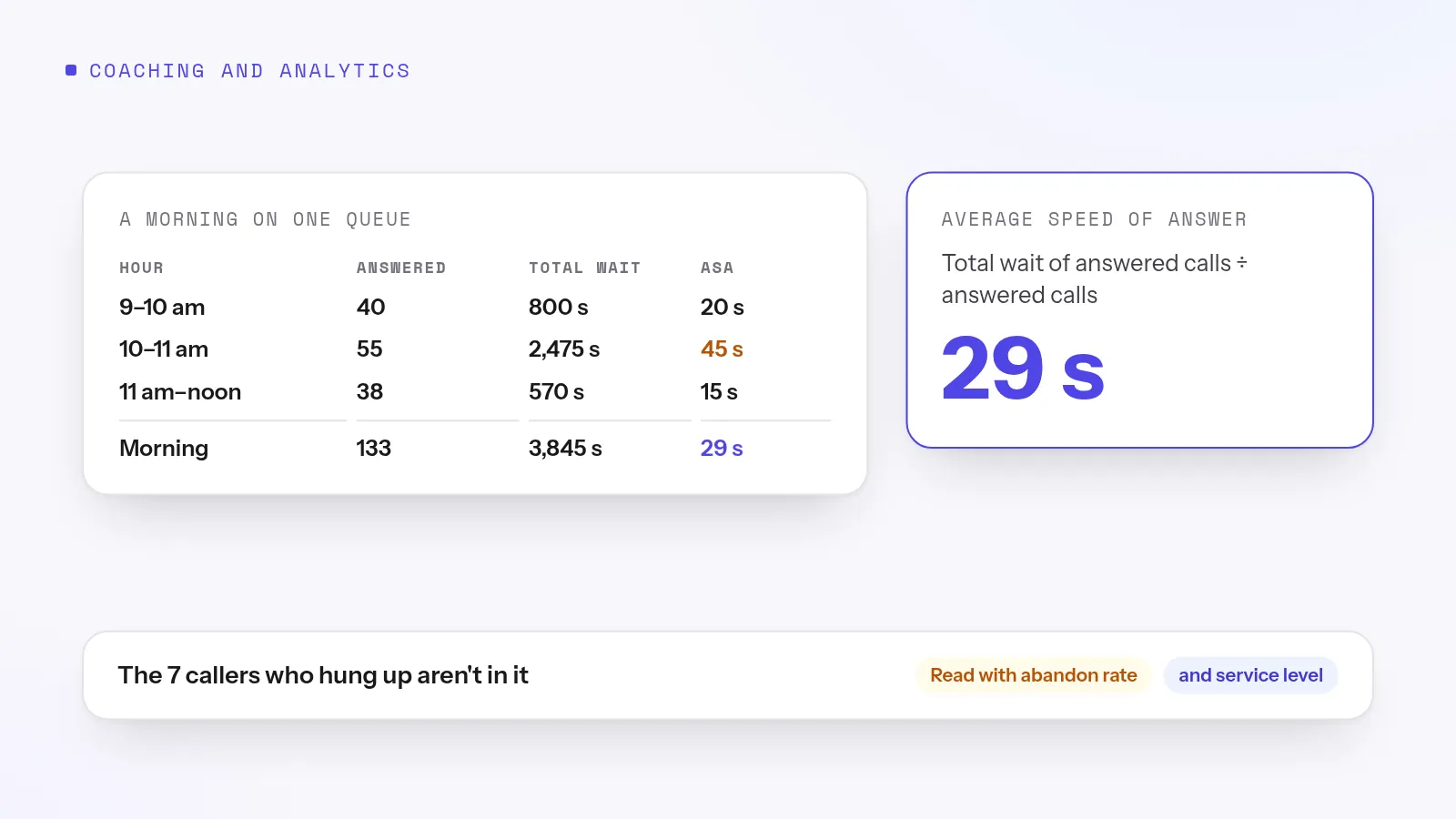
Average speed of answer (ASA) is the average time callers wait in the queue before an agent answers. Divide the total wait time of answered calls by the number of answered calls. Many support teams aim for 20 to 30 seconds, but the right target depends on what callers expect. Read it beside abandon rate and service level, because ASA leaves out the callers who gave up.
ASA = total wait time of answered calls ÷ number of answered calls
Wait time runs from the moment the caller joins the queue to the moment an agent picks up. It doesn't include menu time before the queue, or ringing that happened before the call reached it. Abandoned calls are left out, which is why ASA alone can flatter a team that loses callers.
A worked example
Hour
Answered calls
Total wait
ASA
Abandoned
9–10 am
40
800 s
20 s
1
10–11 am
55
2,475 s
45 s
6
11 am–noon
38
570 s
15 s
0
Morning
133
3,845 s
about 29 s
7
The morning's ASA of about 29 seconds looks fine. The hour-by-hour view shows the real problem: 10 to 11 am, when waits doubled and six callers hung up. Always look at ASA by hour or by half-hour, not as one daily figure.
Watch for two other traps. Calls that overflow from one queue to another can be counted twice, once in each queue, so decide whether wait time follows the caller or the queue. And very short abandons, callers who hang up within a few seconds, are often misdials; many teams leave them out of abandon rate so they don't distort the picture.
Set a service-level target on every queue. It's 60 seconds by default, with a wait limit and an exit for every caller.
Service level is the share of calls answered within a target time, such as 80% within 60 seconds. ASA is an average, so a few very long waits can hide behind many quick ones, or the other way round. Service level tells you how many callers had a good experience; ASA tells you how long the typical wait was. Track both, plus abandon rate. We list the rest of the core numbers in outbound call center metrics, and the after-the-answer side in what is average handle time.
How to bring ASA down
Staff to the busy hours. Most ASA problems are one or two hours a day. Move breaks and lunches out of them.
Cut handle time where it's waste. Shorter wrap-up frees agents sooner, which shortens everyone's wait.
Pick the right ring strategy. Ringing one agent at a time who doesn't answer adds seconds to every call.
Give long waits an exit. A callback or voicemail after a set wait keeps the queue short and the caller's goodwill.
ASA and queues in Adoptiv
Every call queue in Adoptiv carries a service-level target, 60 seconds by default, and a wait limit, 300 seconds by default, after which the caller goes to the exit you chose, such as voicemail or another team. Which agent rings next is set by the queue's ring strategy.
Common questions
What is a good average speed of answer?+
Many support teams aim for 20 to 30 seconds. Sales lines often aim lower, and some service lines accept more if callers expect a wait.
Does ASA include abandoned calls?+
No. It averages answered calls only, so read it with abandon rate.
Is ASA the same as time in queue?+
Close. ASA is the average time in queue for calls that were answered.
Should I measure ASA daily or hourly?+
Hourly, or by half-hour. A daily average hides the busy hours where callers actually wait.
Adoptiv is the dialer, the CRM and the AI on one platform, where the busywork logs itself and your reps just talk. Try it free for 14 days, with no credit card.
Questions? Call +1 (844) 955-7733. SIYA answers and puts you through to a person.