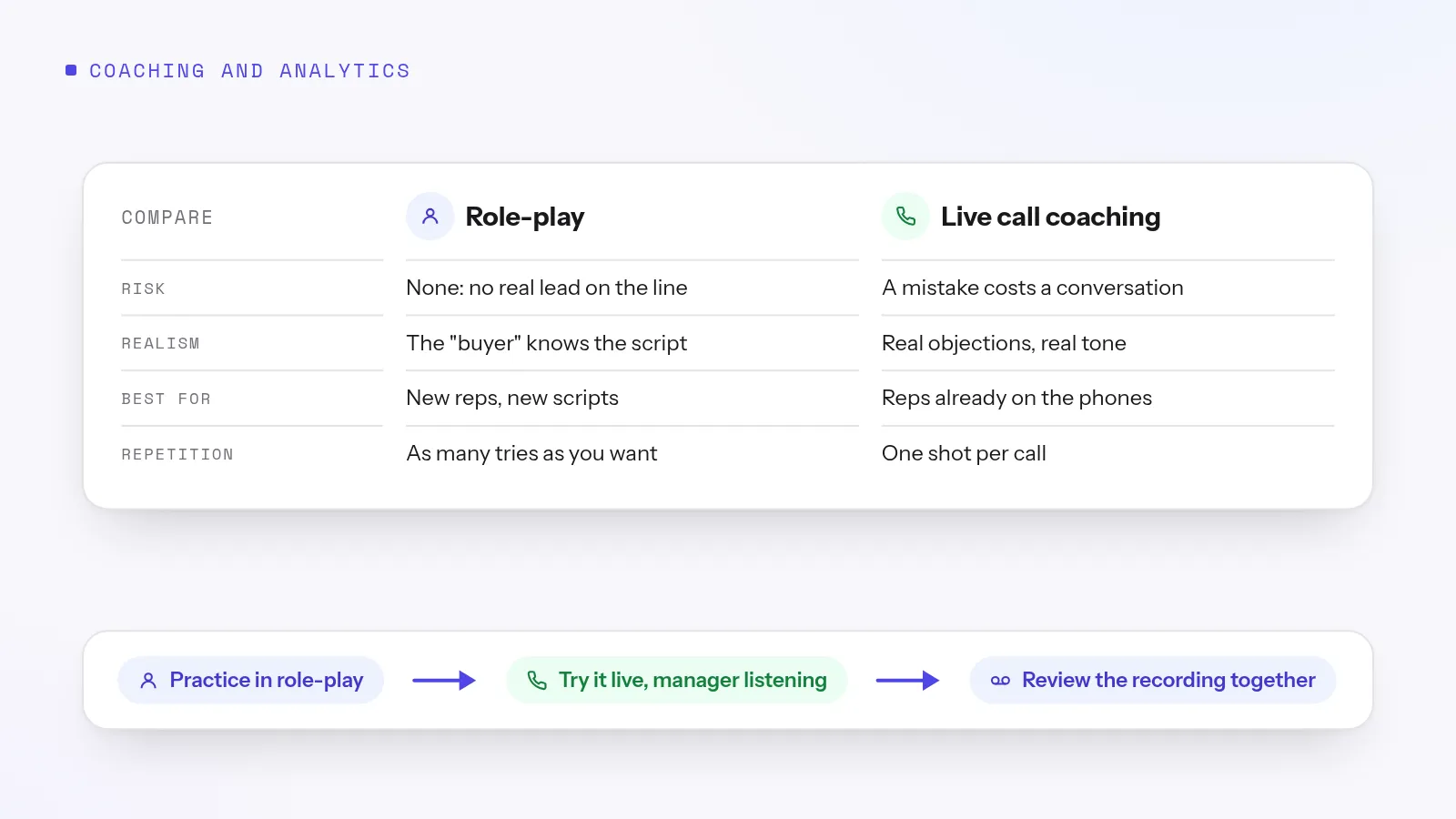
Use role-play to learn a skill before it costs you a lead: new scripts, new objections, new reps. Use live call coaching to fix how that skill holds up on real calls, where buyers don't follow the script. The best programs do both: practice in role-play, try it live with a manager listening, then review the recording together.
Most sales managers lean on one method. Some run role-plays every week; others only coach from real calls. Each has blind spots the other covers. This post is part of our call center metrics and coaching guide.
How they compare
Role-play
Live call coaching
Risk
None: no real lead on the line
Real: a mistake costs a conversation
Realism
Limited: the "buyer" knows the script
Full: real objections, real tone
Best for
New reps, new scripts, rare objections
Reps already on the phones
Repetition
As many tries as you want
One shot per call
Manager time
Scheduled sessions
Listening while calls happen
Running role-play that works
Use real material. Build scenarios from objections reps actually heard this week, not textbook ones.
Keep it short. Five minutes per rep, one skill per round, then swap.
Make the buyer hard, but fair. The person playing the prospect should push back the way real ones do, then give ground when the rep earns it.
Repeat the same scenario. The second and third tries are where the skill sticks.
Try it on your own numbers. Practice in role-play, then coach real calls live: listen, whisper or barge from the live calls board.
Live coaching means a manager on real calls as they happen: listening silently, whispering a hint only the rep hears, or joining the call when it's slipping. Start with listening. Whisper sparingly, a word or two at a time, or the rep stops listening to the buyer. Barge in only when the call will be lost otherwise. Our guide to call whisper and barge covers each mode in detail.
After the call, spend two minutes with the rep while it's fresh: one thing that worked, one thing to try next time. Rules on monitoring and recording calls vary by state, so add your own notice where it's needed. This is general information, not legal advice, so check with your own counsel.
Mixing the two
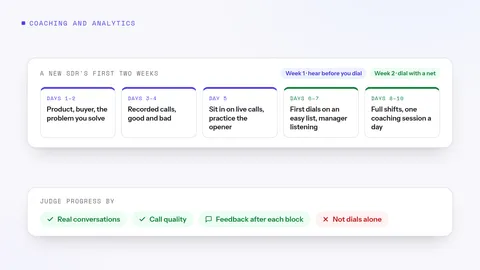
A simple weekly rhythm: one short role-play session on the week's hardest objection, live listening on a few calls per rep, and a recording review on Friday. New reps get more role-play and more listening; experienced reps get less role-play and more recording reviews. A QA scorecard keeps feedback consistent, and our guide to sales call coaching covers the conversation itself.
Live coaching in Adoptiv
Role-play happens between people; Adoptiv helps with the live part. The live calls board shows calls in progress, with the rep, the contact, the queue and how long each has run. Admins can join any call; anyone else needs the "Supervise calls" permission, which covers the calls of people on their teams or who report to them, checked before they join. Listen, whisper and barge run on the same connection, so you can switch between them without dropping anything, and the customer never hears a whisper. The rep's recording carries on underneath, so you can review the call together afterwards.
To pick which recordings to review, call scoring on AI+ and Dialer Plus rates analyzed calls 0 to 10 on communication, issue resolution, customer satisfaction and compliance, plus an overall score.
Common questions
Is role-play still useful for experienced reps?+
Yes, for new products, new scripts and rare objections they haven't met yet. Keep it short and focused on one skill.
What is live call coaching?+
A manager coaching on real calls as they happen, by listening, whispering hints only the rep hears, or joining the call.
Does the customer hear a whisper?+
No. A whisper reaches only the rep. In Adoptiv, a barge is the mode where you join the call and everyone hears you.
How often should managers listen to live calls?+
Daily for new reps in their first weeks, then a few calls per rep each week, plus a recording review.
Adoptiv is the dialer, the CRM and the AI on one platform, where the busywork logs itself and your reps just talk. Try it free for 14 days, with no credit card.
Questions? Call +1 (844) 955-7733. SIYA answers and puts you through to a person.