Call sentiment analysis: what it tells a sales manager (and what it doesn't)
Adoptiv Team··Updated ·3 min read
Short answer
Call sentiment analysis uses AI to mark each analyzed call positive, neutral or negative, based on how it went for the customer. Its real value is triage: instead of listening to random calls, a manager filters for the negative ones and listens to those. It works best alongside tone (how the conversation came across) and intent (what the customer wanted).
Most managers listen to only a small share of their team's calls, and usually not the ones that matter. A customer who hung up annoyed rarely complains. They just don't buy. Sentiment analysis is a way to find those calls without listening to everything. This post is part of our guide to AI for business phone calls, and sits beside conversation intelligence for small sales teams, which covers the wider set of call insights.
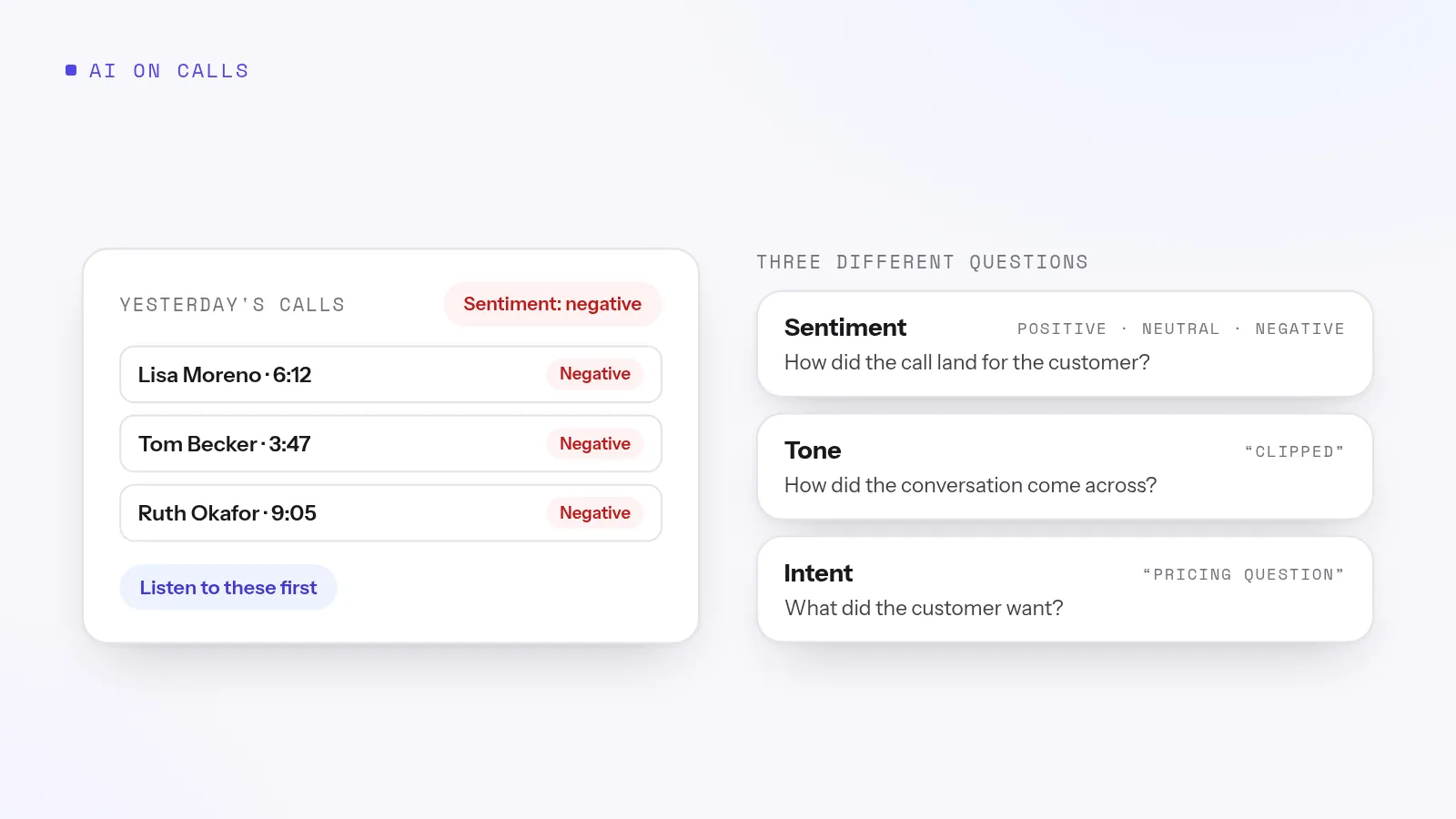
Sentiment, tone and intent: three different questions
Sentiment
Tone
Intent
Question it answers
How did the call land for the customer?
How did the conversation come across?
What did the customer want?
Typical output
Positive, neutral or negative
A word such as "clipped" or "apologetic"
Labels such as "pricing question"
Best use
Finding unhappy customers
Coaching how reps sound
Counting why people call
Can it be averaged?
Yes
Not easily; you count the words
You count the labels
Where sentiment analysis goes wrong
Short calls. A 20-second "not interested" has too little to judge. A good system skips these or marks them neutral rather than guessing.
Polite but negative. A customer can be friendly while saying no. Tone catches this better than a three-way verdict.
One verdict for the whole call. A call that started badly and ended well is summed up in one word. Read the call before judging the rep.
It isn't a score of the rep. A negative call can be a rep handling an angry customer well.
Try it on your own numbers. On AI+ and Dialer Plus, each analyzed call on your own number gets a sentiment verdict, a tone word and its main reason.
Call back the unhappy customers. Filter yesterday's calls for negative ones and decide who needs a follow-up from a manager.
Pick coaching calls. Choose two negative calls per rep for the weekly session. Our sales call coaching routine shows how to run it.
Watch the trend, not the call. A rep whose share of negative calls rises over two weeks is worth a conversation. One bad day isn't.
Check promises. Pair sentiment with what the rep committed to. Negative calls with unkept promises are the ones that turn into complaints.
How Adoptiv does it
On AI+ and Dialer Plus, calls on each rep's own number are transcribed and read once after they end. Very short calls are skipped: automatic analysis needs at least 30 seconds of talk (60 seconds on outbound calls), and admins can set a higher minimum or switch it off. Sentiment analysis gives each analyzed call one verdict for the whole call, positive, neutral or negative, in a field of its own that you see on the call. A call with too little said to judge comes out neutral rather than guessed. It's a verdict on the finished call, not a live meter, and there are no live alerts.
Tone analysis sums up each analyzed call in one word that fits it, such as clipped, resigned or apologetic. The word is read from what was said, not from pitch or volume. Intent detection lists what the customer asked for and what the rep promised as two separate lists, and names the main reason for the call. You see all three when you open the call. They come from the same reading, and on AI+ and Dialer Plus they're unlimited for calls on your own number. For the written side of the same reading, see AI call summaries.
Common questions
How accurate is call sentiment analysis?+
Good enough to sort calls, not to judge one call alone. Use it to decide which calls to listen to, then listen.
Is sentiment shown during the call?+
In Adoptiv, no. It's a verdict on the finished call, read from the whole transcript.
What's the difference between sentiment and tone?+
Sentiment is how the call landed: positive, neutral or negative. Tone is how the conversation came across, in a word such as "grudging" or "warm".
Should sentiment count toward a rep's targets?+
We'd advise against it. Reps can't control how every customer feels, and a target invites them to avoid difficult calls.
Adoptiv is the dialer, the CRM and the AI on one platform, where the busywork logs itself and your reps just talk. Try it free for 14 days, with no credit card.
Questions? Call +1 (844) 955-7733. SIYA answers and puts you through to a person.