A small team can forecast well with two numbers per deal: its amount and the win probability of the stage it sits in. Add them up as a weighted pipeline, then ask each rep which deals they'd stake their name on this month. Where the two disagree is where the manager should look.
Forecasting sounds like a job for a finance team and a spreadsheet model. For a team of five reps it's mostly about honest stages and a weekly habit. This post is part of our complete guide to a CRM with a built-in phone system.
Method 1: the weighted pipeline
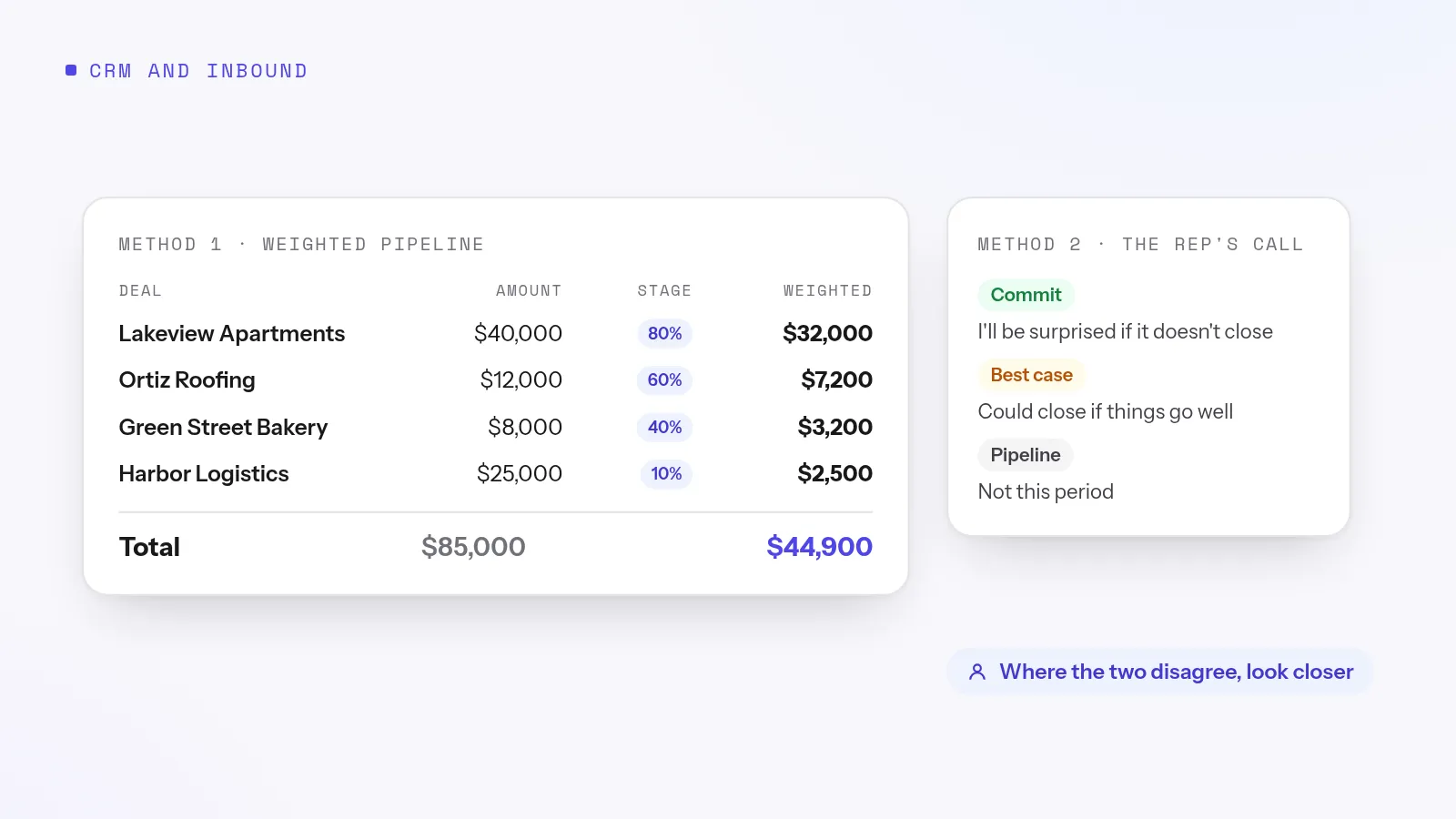
Give every pipeline stage a win probability: the share of deals at that stage that usually close won. Multiply each deal's amount by its stage's probability and add the results. That total is your weighted pipeline.
Deal
Amount
Stage
Win probability
Weighted
Lakeview Apartments
$40,000
Negotiation
80%
$32,000
Ortiz Roofing
$12,000
Proposal
60%
$7,200
Green Street Bakery
$8,000
Needs analysis
40%
$3,200
Harbor Logistics
$25,000
Prospecting
10%
$2,500
Total
$85,000
$44,900
The weighted total is not a promise that any single deal closes. It's an estimate of what the whole pipeline is worth if your stage odds are right, and it gets better the more deals you have. With ten open deals, one big win or loss swings it a lot.
Method 2: the rep's call
Ask each rep to sort their open deals into three groups for the period: commit (I'll be surprised if it doesn't close), best case (it could close if things go well) and pipeline (not this period). Reps know things the stage doesn't: the buyer went quiet, or the budget was just approved.
Compare the two methods every week. A rep whose commits keep slipping needs coaching on qualifying. A rep who never commits anything may be sandbagging.
Try it on your own numbers. Give every stage its own win odds and see where each deal stands, with every stage change on record.
Set stage odds from your own history. Look at last quarter's deals: of those that reached Proposal, how many closed won? Use that, not a template's number.
Define what moves a deal. "Proposal" should mean a proposal was sent, not that one is being written. Our post on sales pipeline stages for deals covers exit criteria for each stage.
Date every deal. A deal without an expected close date can't be in this month's forecast.
Clean up stale deals. A deal nobody has touched in weeks should move back a stage or close lost.
Feed it good leads. A forecast is only as good as what enters the pipeline; lead scoring helps reps spend time on the right ones.
A 20-minute weekly forecast meeting
Weighted total and commits for the period, next to last week's numbers.
Deals that moved backward or slipped their close date, and why.
The three biggest deals: what has to happen next, and who does it.
One decision: where the team spends its time this week.
Deal forecasting in Adoptiv
In Adoptiv's deals and pipelines, you can build as many pipelines as you sell through, and each stage of a pipeline you build carries its own win probability from 0 to 100. Every stage change is written on the deal with the name of whoever made it, so a slipped deal leaves a trail. Won and lost reasons are kept, each deal holds its amount in its own currency, and each deal can be assigned to one owner. It sits in the same sales CRM as the leads and calls that feed it.
Common questions
What is a weighted pipeline?+
The sum of every open deal's amount multiplied by its stage's win probability. It estimates what the pipeline is worth, not what any one deal will bring.
How accurate is a weighted forecast for a small team?+
It's rough with few deals, because one large win or loss moves it a lot. Pair it with each rep's own commit list and read both weekly.
How do I set win probabilities for each stage?+
From your own closed deals: for each stage, the share of deals that reached it and then closed won. Revisit the numbers each quarter.
How often should a small team forecast?+
Weekly. A short, regular review catches slipping deals while there's still time to act.
Adoptiv is the dialer, the CRM and the AI on one platform, where the busywork logs itself and your reps just talk. Try it free for 14 days, with no credit card.
Questions? Call +1 (844) 955-7733. SIYA answers and puts you through to a person.