First call resolution (FCR) is the share of customer issues solved on the first call, with no follow-up call needed. The simplest formula is issues resolved on the first call divided by all first calls. Many support teams land between 70% and 80%. FCR is worth tracking because repeat calls cost you twice and frustrate the customer, but measure it honestly: a short call that sends the customer back tomorrow isn't a resolution.
Of all the inbound numbers, FCR is the one customers would pick if you asked them. It's the difference between "sorted" and "I'll have to call again". This post is part of our guide to call center metrics and coaching.
Three ways to measure FCR
Method
How it works
Strength
Weakness
Agent-marked
The agent marks the call resolved at wrap-up
Easy, every call counted
Agents tend to rate their own calls generously
Repeat-call window
A call counts as resolved if the same number doesn't call back within a set window, often 3 to 7 days
Based on behavior, not opinion
A customer may call back about something new
Customer survey
Ask "Was your issue resolved today?" after the call
The customer's own view
Low response rates, and happy customers answer more
Most teams combine the first two: agents mark resolution, and a repeat-call check keeps the figure honest. Whatever you choose, write the rule down and keep it fixed, or the trend means nothing.
A worked example
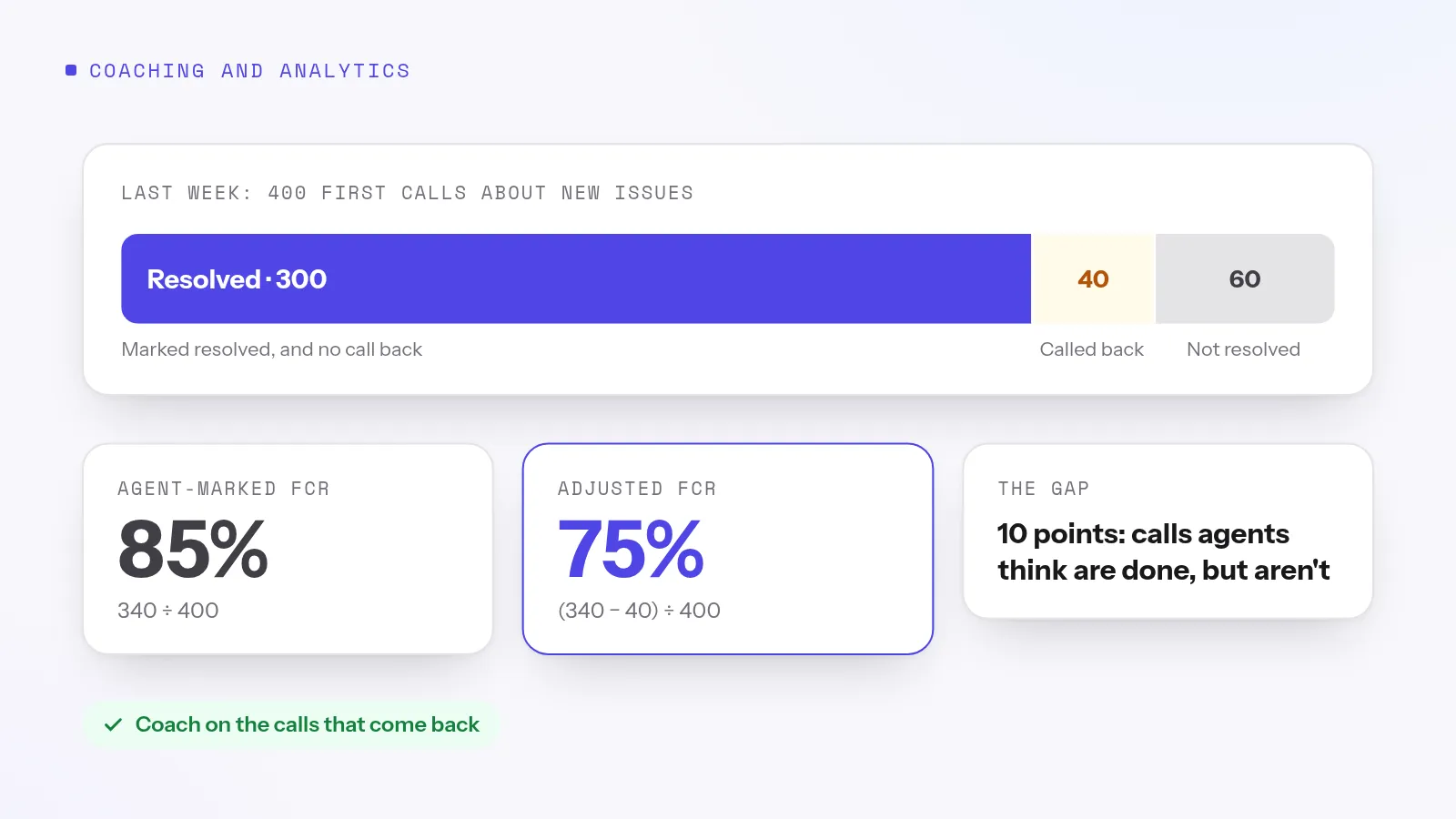
Last week your team took 400 first calls about new issues. Agents marked 340 as resolved. Of those 340, 40 customers called back about the same issue within five days.
FCR pulls against handle time. Push agents to keep calls short and FCR often drops, because the hard part of the problem gets pushed to the next call. Read the two together, as we explain in what is average handle time. Long waits hurt FCR too, since frustrated callers hang up before the fix is finished; see average speed of answer.
How to raise FCR
Find the repeat reasons. Group call-backs by topic. Two or three topics usually account for most of them.
Give agents the authority. A refund or exception that needs a manager's approval is a guaranteed second call.
Route to the right person the first time. A transfer isn't a failure, but a call that reaches someone who can't help is.
Close the loop on the call. Confirm the fix while the customer is still on the line, and say what happens next.
Use clean outcome codes. A short list of call disposition codes, including "resolved" and "needs follow-up", makes FCR something you can count.
Tracking resolution in Adoptiv
In Adoptiv, every call ends with an outcome, and the wrap-up asks for one before the rep moves on. Ready-made codes come with every workspace; adding your own, such as "Resolved" and "Needs follow-up", is part of Campaigns, which are in early access. The outcome's name is stored on the call, so renaming a code later doesn't change last month's figures. Call summaries note why the customer called and what happens next, which makes repeat reasons easier to spot. They are part of AI call analysis, included on AI+, Dialer Plus and Enterprise for calls on a rep's own number; other calls are paid from your prepaid wallet. Summaries skip very short calls, under 30 seconds of talk (60 seconds for outbound).
Common questions
What is a good first call resolution rate?+
Many support teams land between 70% and 80%. Simple, repetitive questions can run higher; technical support often runs lower.
Is FCR the same as first contact resolution?+
Nearly. First contact resolution counts email, chat and texts as well as calls. FCR usually means phone only.
Should transferred calls count as resolved?+
If the issue was solved within the same call, yes. Decide the rule once and apply it every week.
What window should I use for repeat calls?+
Three to seven days is common. Shorter windows flatter the number; longer ones catch unrelated calls.
Adoptiv is the dialer, the CRM and the AI on one platform, where the busywork logs itself and your reps just talk. Try it free for 14 days, with no credit card.
Questions? Call +1 (844) 955-7733. SIYA answers and puts you through to a person.