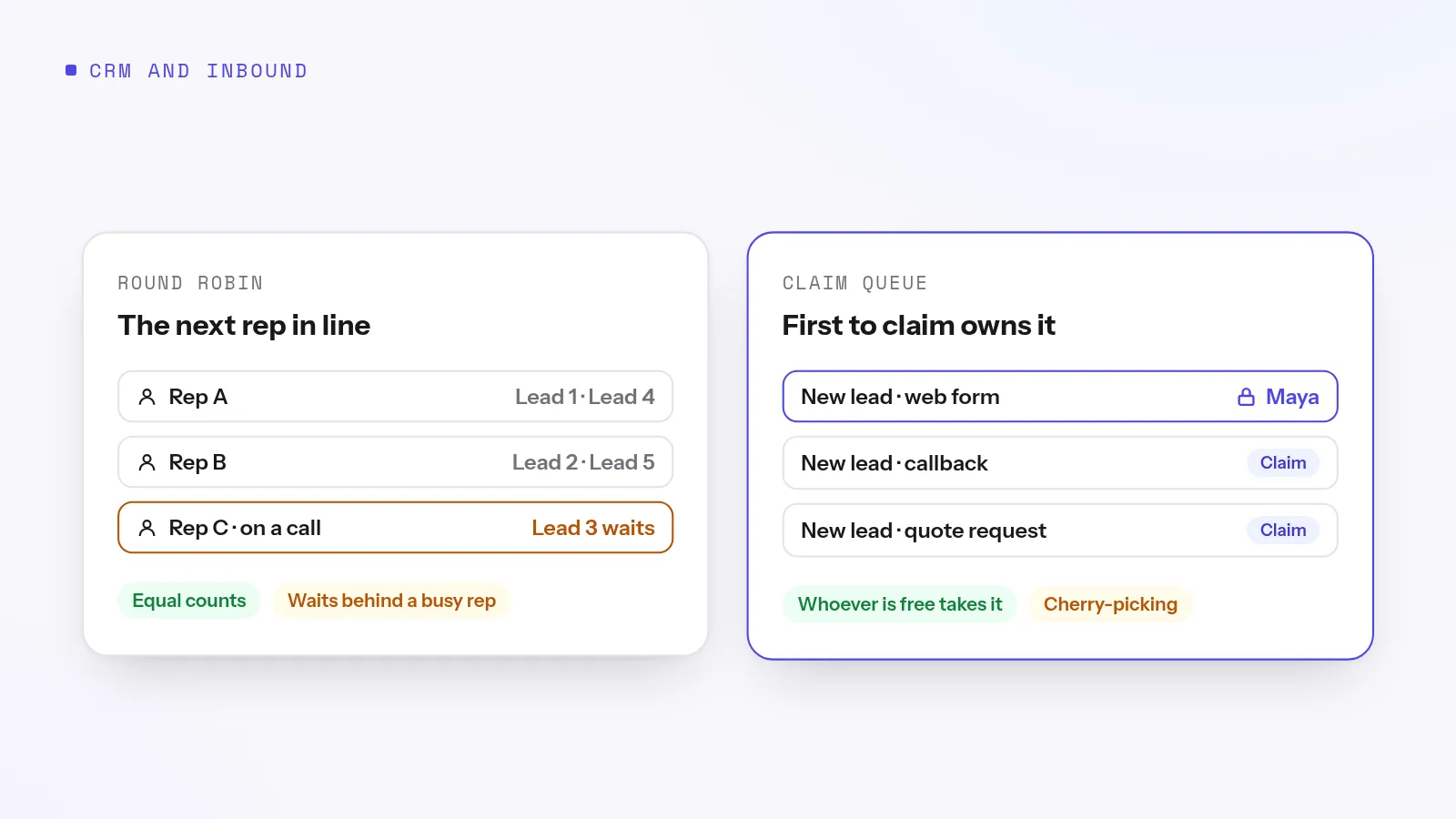
Round robin hands each new lead to the next rep in line, so leads are shared evenly whether or not that rep is free. A claim queue puts new leads where a whole team can see them, and the first rep who claims one owns it. Round robin is fairer on paper; a claim queue is faster on a busy floor. Many teams use round robin for scheduled work and a claim queue for hot inbound leads.
Round robin suits leads that don't go cold in five minutes: an imported list, a batch of renewals, last month's no-shows. Everyone gets the same number, nobody argues about who got the good ones, and you can compare reps fairly because they worked the same mix. Its weak spot is speed. A lead assigned to someone on a long call, at lunch or out sick just waits. If you use round robin for fresh leads, add a rule that moves a lead on if nobody calls it within a set time.
Drop leads into a team queue and let reps claim them. Once someone holds a lead, nobody else can take it.
A claim queue suits leads where every minute counts, which is most web form leads. We explain why in speed to lead. The lead lands where the whole team can see it, and the first free rep takes it. Its weak spot is fairness. Fast reps take more, and some reps skip leads that look hard. Watch claim counts per rep each week, and make claiming a lead mean calling it now.
Rules that keep it clean
One owner at a time. Once a lead is held, nobody else should be able to take it, so two reps never call the same person.
A clock on every lead. Decide how long a lead may sit unclaimed or uncalled before a manager steps in.
Separate queues for separate work. Inbound leads, aged lists and callbacks shouldn't share one queue.
Leads arrive with their source. Knowing a lead came from a web form or a list changes how fast it should be called. Routing web leads in cleanly is covered in how to send web form leads to your CRM.
Lead assignment and call distribution are different problems. For deciding which rep a live incoming call rings, see round robin call distribution.
Lead assignment in Adoptiv
In Adoptiv a lead goes to a rep, a role or a team. A lead sent to a role or a team waits in that queue, in view of everyone in it, until one person claims it. Claiming puts your name on it, and once someone holds a lead a second claim is refused. Claiming needs permission to update leads, and what each person can see and edit is set by roles and permissions.
Common questions
Is round robin lead assignment fair?+
It gives every rep the same number of leads. It isn't always fair on speed, because a lead can wait behind a busy rep.
What is a claim queue?+
A shared list of unassigned leads. Any rep in the queue can take one, and it becomes theirs alone.
How do I stop reps from cherry-picking leads?+
Track claims per rep, expect a call soon after each claim, and use round robin for lists where choosing doesn't matter.
Can I use both?+
Yes. Many teams use a claim queue for fresh inbound leads and round robin for imported or aged lists.
Adoptiv is the dialer, the CRM and the AI on one platform, where the busywork logs itself and your reps just talk. Try it free for 14 days, with no credit card.
Questions? Call +1 (844) 955-7733. SIYA answers and puts you through to a person.