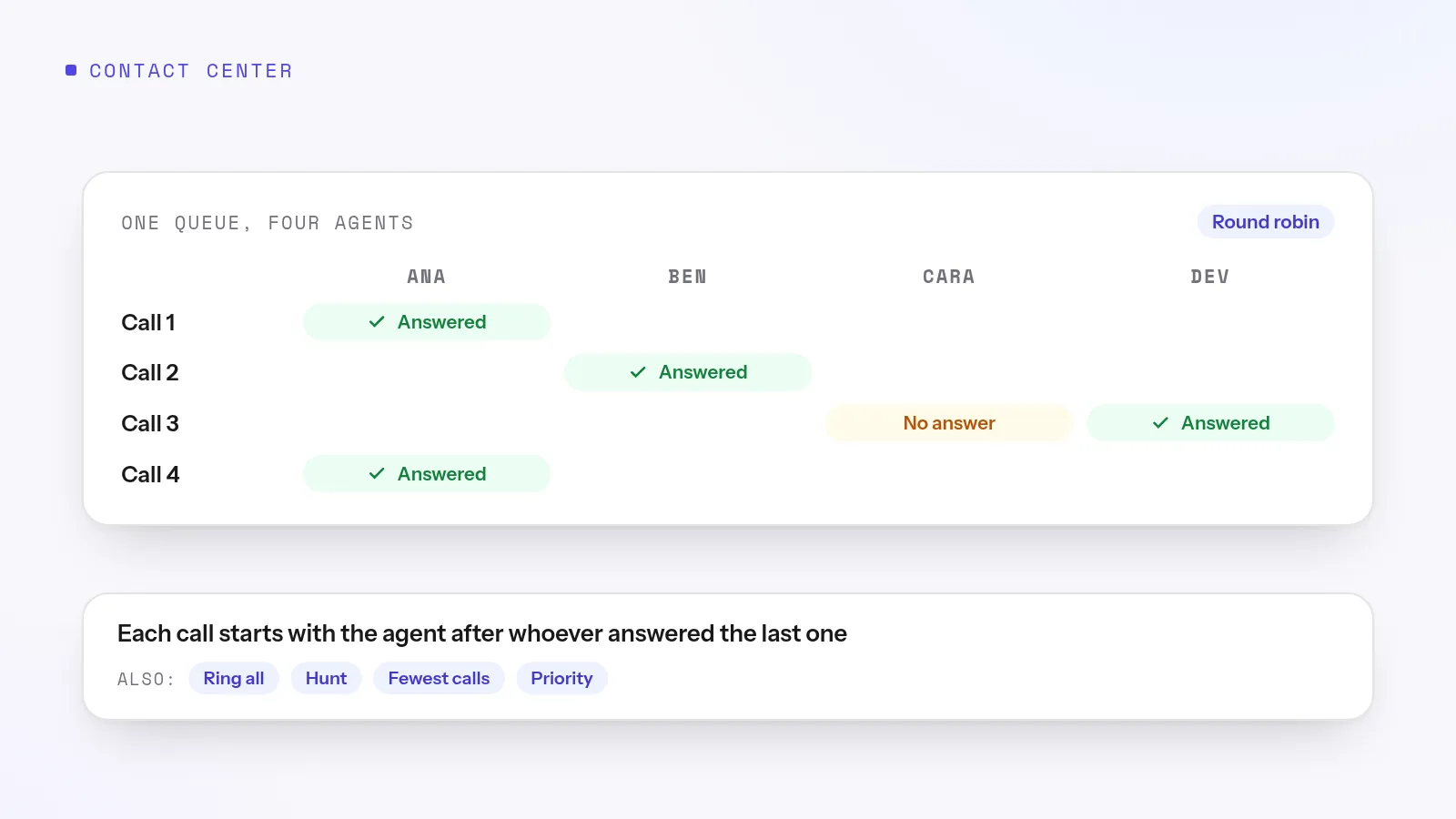
Round robin call distribution rings one agent at a time and starts each new call with the agent after whoever answered the last one, so calls rotate evenly through the team. It's the usual choice when you want to share the work fairly. Ring all is faster for a tiny team, because everyone rings at once, and fewest calls balances load better when some agents take longer calls than others.
The rule that decides which agent an incoming call rings next is called the ring strategy, and it's the heart of automatic call distribution. This post is part of our guide to contact center software for small teams.
How round robin works
A call arrives in the queue. The system rings the agent after whoever answered the previous call. If that agent doesn't pick up in time, it moves on to the next one, and so on around the list. The next call starts one place further along. Over a day, every available agent is offered roughly the same number of calls.
Round robin compared
Strategy
Who rings
Best for
Weak spot
Round robin
One agent, rotating
Sharing calls evenly
A caller may ring past a few agents first
Ring all
Everyone at once
Tiny teams, fastest pickup
The quickest agents take everything
Hunt
One at a time, in list order
A fixed first responder
The top of the list does most work
Fewest calls
Whoever answered least
Uneven call lengths
New joiners get flooded at first
Priority
Highest rank first
Senior or specialist staff first
Lower ranks wait for overflow
Random
A shuffled order
Avoiding patterns
No fairness guarantee per day
Share incoming calls fairly. Pick round robin, ring all or fewest calls on any queue, and rank who rings first.
Commission or quota depends on calls taken. Reps will ask whether calls are shared fairly. Round robin answers that.
The team is bigger than about five. Ringing ten phones at once for every call gets noisy, and the same two people grab most of them.
Calls are similar in length. If some calls run 30 minutes and others two, fewest calls or a separate queue may be fairer.
Round robin also works better with a short wrap-up gap, so an agent who just hung up isn't rung again before they've saved their notes. Check how your system handles that gap, and whether it's a setting at all. If your question is ring groups versus queues rather than which strategy, start with call queue vs ring group. Handing out leads, rather than live calls, is a different problem, covered in lead assignment: round robin vs claim queues.
Round robin in Adoptiv
Every call queue in Adoptiv has one of six ring strategies: ring all, which is the default, hunt, round robin, fewest calls, random and priority. It's a setting on the queue you already have, so switching to round robin means changing it there. Members carry a rank, and each ring attempt lasts 30 seconds by default. After a queue call, a member gets a short, fixed wrap-up pause before the queue rings them again. Ring all is capped at 20 members per queue, because every call rings every phone; one-at-a-time strategies such as round robin allow up to 200.
Common questions
What's the difference between round robin and ring all?+
Ring all rings every agent at once and the first to answer takes the call. Round robin rings one agent at a time, rotating through the team.
Is round robin the same as a hunt group?+
No. A hunt group always starts at the top of the list. Round robin starts after whoever took the last call.
What happens if the next agent doesn't answer?+
The call moves on to the next free agent. In Adoptiv, round robin rings each free agent once; if nobody answers in that pass, the call leaves the queue through its timeout exit rather than going round again.
Does round robin skip busy agents?+
Yes. Agents already on a call aren't rung, so the next free agent in the rotation gets it.
Adoptiv is the dialer, the CRM and the AI on one platform, where the busywork logs itself and your reps just talk. Try it free for 14 days, with no credit card.
Questions? Call +1 (844) 955-7733. SIYA answers and puts you through to a person.