Call queue vs ring group: which one your phone line needs
Adoptiv Team··4 min read
Short answer
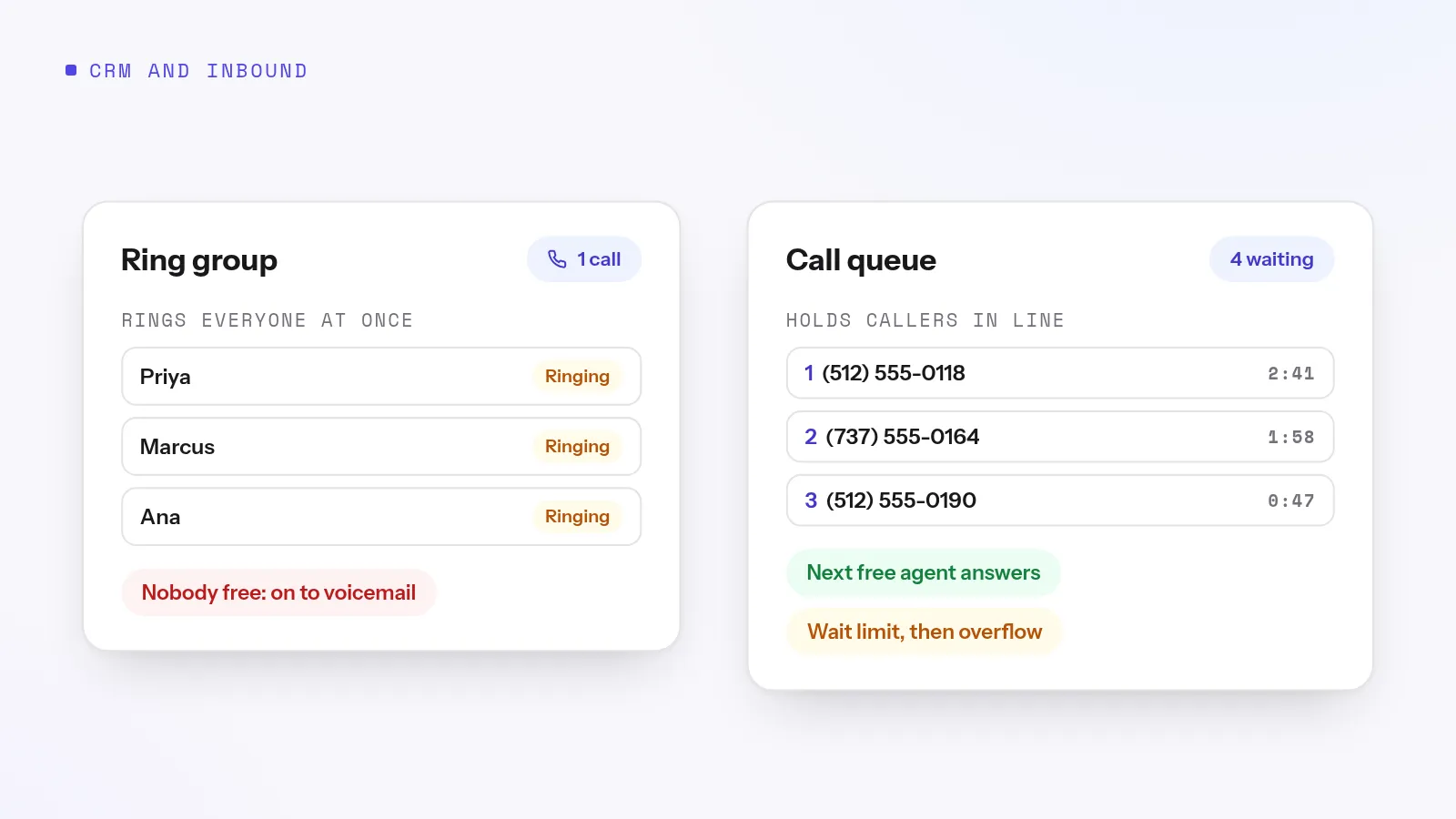
A ring group rings a set of people when a call comes in, all at once or in turn, and if nobody answers the call moves on. A call queue holds the caller when everyone is busy, plays hold music, and connects them as soon as someone is free. Use a ring group for a small team that can answer most calls live. Use a queue when calls arrive faster than people can answer them.
Both decide who rings when your main number is called, so the terms get mixed up, and many phone systems now blur them. The practical difference is what happens to a caller when nobody is free. A ring group sends them on, usually to voicemail. A queue keeps them waiting, for as long as you allow.
The difference at a glance
Ring group
Call queue
When everyone is busy
The call goes to the fallback, often voicemail
The caller waits in line
What the caller hears
Ringing
A welcome, hold music, announcements
Who rings
Members, by a ring strategy
Members, by a ring strategy
Wait limit
A few ring cycles
Set by you, then an overflow exit
Best for
Small teams, low call volume
Busy lines, support and sales floors
Ring strategies: who rings first
Ring groups and queues both use a ring strategy, the rule for which person's phone rings next. Phone systems call this automatic call distribution (ACD). These are the six you'll see most often:
Strategy
How it rings
Good for
Ring all (simultaneous)
Everyone at once; the first to answer keeps the call
Fast pickup on a small team
Hunt
One at a time, in a fixed order
A front desk with backups
Round robin
Starts after whoever took the last call
Sharing inbound sales leads fairly
Fewest calls
Whoever has answered the fewest calls first
Balancing workload
Priority
By rank: senior or specialist people first
Demanding or high-value lines
Random
A shuffled order for each call
Rarely the best choice; avoids patterns
Ring all against round robin is the most common choice. Ring all gets calls answered fastest, but the same two quick people end up taking most of them. Round robin spreads the work, at the cost of a few extra seconds while it tries each person in turn.
When a ring group is enough
You have two to five people who can each take any call.
Most calls are answered live, and the rest are fine going to voicemail.
Callers are mostly existing customers who will call back or leave a message.
Try it on your own numbers. Adoptiv puts the dialer, the phone system and the CRM in one tool. Fourteen days free, with the AI switched on.
Calls bunch up at certain hours and people are often all on the phone.
A missed caller is a lost sale, so voicemail is the wrong fallback.
You need to know how long people waited and how many gave up.
Some callers, such as key accounts, should reach someone sooner than others.
Five settings that keep a queue from going wrong
A wait limit. Nobody should hold forever. Pick a limit and decide where the call goes when it's reached.
An exit for every case. Waited too long, nobody available, and nobody with the right skills are different problems and may need different answers.
A short welcome. Play it only when nobody is free, so a caller who would be answered at once isn't held up by a greeting.
A way off hold. Offer a callback after a minute or two, so callers who can't wait don't simply hang up.
Breathing room. Let someone who has just hung up finish their notes before they ring again.
How Adoptiv handles it
In Adoptiv the queue is the ring group. Every call queue has a wait limit, 300 seconds by default, and an optional cap on how many callers can wait. Waited too long, nobody available, no agent with the right skills, and a repeat caller are four separate overflow exits, each sent to voicemail, another queue, a team, a person, a menu, a call flow or an outside number. A blank exit hangs up, so set them all. The welcome can play always, only when nobody is free, or never. Callers don't hear their place in line; offer a callback instead.
Six ring strategies are a setting on each queue: ring all (the default), hunt, fewest calls, random, round robin and priority. Each ring lasts 30 seconds by default, members can be ranked, and anyone still in wrap-up can sit a round out. With VIP priority routing switched on for a queue, contacts flagged VIP start 60 seconds ahead in line, and anyone who has really waited longer is still served first. Queues and routing come with every plan.
Common questions
What is a ring group?+
A set of people who share calls to one number, rung all at once or in turn. If nobody answers, the call moves on to a fallback such as voicemail.
Is a hunt group the same as a ring group?+
A hunt group is a ring group that rings members one at a time in a fixed order. "Ring group" usually covers every strategy, including ringing everyone at once.
Should I use ring all or round robin?+
Ring all if speed matters most and the team is small. Round robin if the work should be shared evenly, such as inbound sales leads.
How long should callers wait in a queue?+
There's no single right number. Look at when your callers start hanging up, set the limit before that, and offer a callback or another team at the limit.
Adoptiv is the dialer, the CRM and the AI on one platform, where the busywork logs itself and your reps just talk. Try it free for 14 days, with no credit card.
Questions? Call +1 (844) 955-7733. SIYA answers and puts you through to a person.