Call transcription vs call summaries: what each is for
Adoptiv Team··3 min read
Short answer
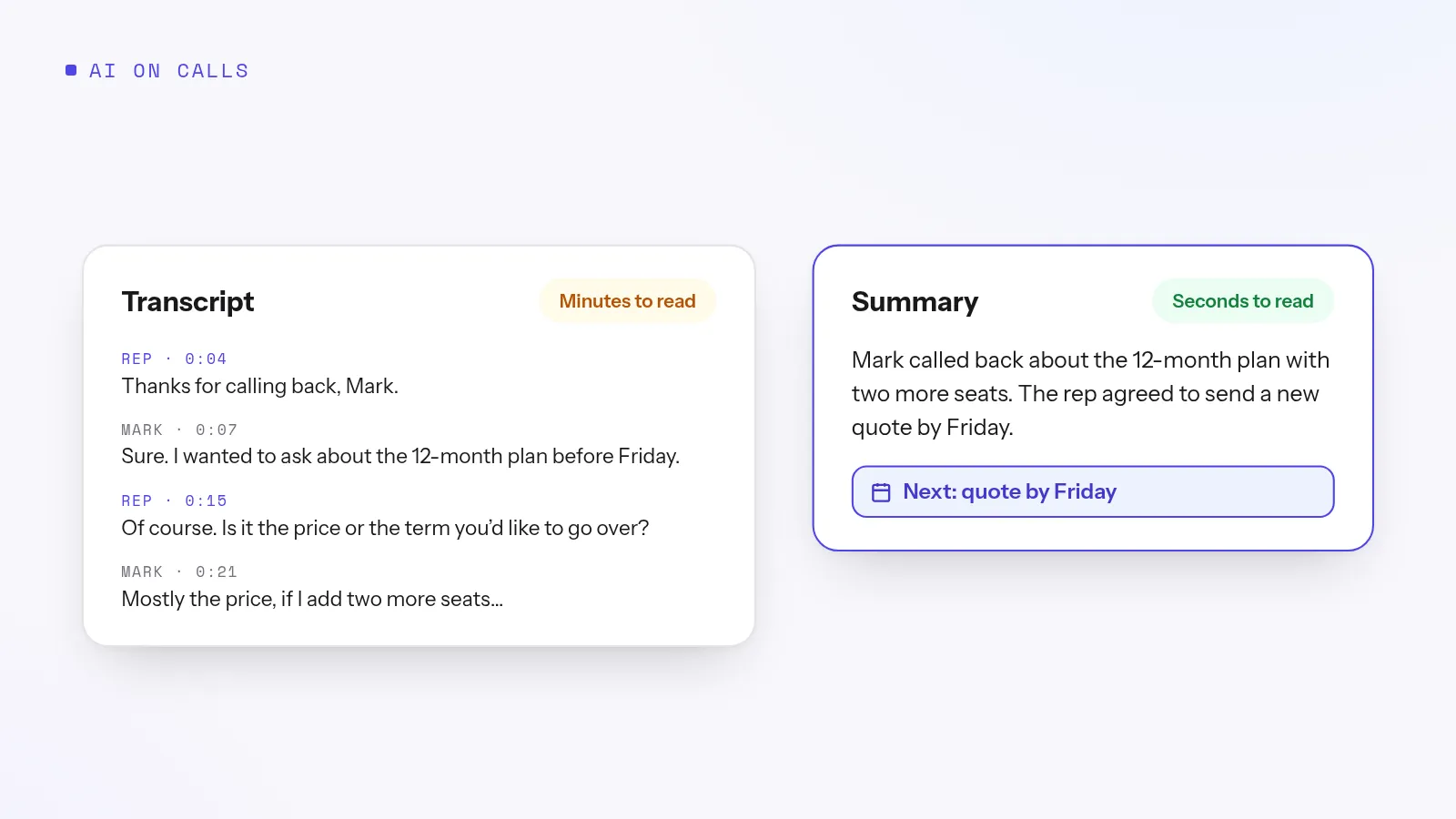
A call transcript is every word, ideally split by who said it. A call summary is a few sentences on why the call happened, what was agreed and what comes next. Reps and anyone picking up a lead need the summary. Coaches, quality reviewers and disputes need the transcript. A good system gives you both on the same call, with no typing.
"We record our calls" used to mean a folder of audio nobody had time to play. Transcription made calls readable, and AI summaries made them skimmable. They're often sold as one feature, but they answer different questions, and knowing which you need saves you from buying the wrong thing or reading the wrong one.
Transcript vs summary
Transcript
Summary
What it is
Every word, line by line
A few sentences on what happened
Time to read a 10-minute call
Several minutes
Seconds
Best for
Coaching, quality checks, disputes, exact quotes
The next call, handovers, managers skimming
Main risk
Words credited to the wrong speaker
Detail left out, or a guess filling a gap
Who reads it
Coaches, QA, compliance reviewers
Reps, managers, anyone who opens the record
Why speaker labels matter
A transcript is only useful for coaching if you know who said each line. Many tools guess the speaker from voices, and they get it wrong on crosstalk, short replies and similar voices. Then a coaching note quotes the customer's objection back at the rep as if the rep said it. The reliable way is to record each side on its own channel, so the labels come from the recording rather than from a guess.
What a good summary covers
Why the call happened: "Called back about the roof quote."
What was covered: "Asked about financing and the start date."
How it ended: "Wants to talk to her husband first."
What happens next: "Call back Thursday after 5."
Watch for summaries that pad a 20-second call into a paragraph. A short call should get a short summary, not an invented one.
Try it on your own numbers. Adoptiv puts the dialer, the phone system and the CRM in one tool. Fourteen days free, with the AI switched on.
Weekly coaching: the transcript of two or three calls, with exact quotes. Our after-call work guide covers the time summaries save reps.
A customer complaint: the transcript and the recording.
A manager's daily skim: summaries.
What to check before you buy
Does a bot have to join the call, or does it work from the phone system's own recording?
How are speakers labeled, by channel or by guess?
Are voicemails transcribed and summarized too?
Can very short calls be skipped?
Is it priced per minute, or unlimited on a plan?
How Adoptiv does it
Adoptiv's phone system records each side of a call on its own channel, so call transcripts mark every line agent or customer from the recording itself. A new line starts when the speaker changes or pauses for more than 1.2 seconds, and each line keeps its time from the start of the call. If a call comes out reversed, one toggle swaps the sides for that call. A single-channel recording gets a plain transcript, with no guessed labels. You can choose to mask strong language; words can't be corrected by hand. Voicemail transcripts are searchable from the voicemail list, while the call list searches by name, agent and number rather than transcript words.
From the transcript, SIYA, Adoptiv's AI, writes call summaries of one to six sentences: why the call happened, what was covered, the outcome and the next step. No bot joins the call. You choose calls, voicemails or both, a minimum length, and whether it runs automatically or on demand. A short or unclear call gets a short, neutral summary. Summaries can't be edited by hand; running the analysis again replaces them. Agreed next steps are proposed as callbacks and meetings through follow-up extraction. AI call analysis is unlimited on the AI+ and Dialer Plus plans for calls on your own number.
Common questions
What is the difference between a call transcript and a call summary?+
A transcript is every word of the call. A summary is a few sentences on why it happened, what was covered and what comes next.
Do I need both?+
Most teams do: summaries for day-to-day follow-up, transcripts for coaching and checking exactly what was said.
How accurate are speaker labels?+
Labels read from separate recording channels are reliable. Labels guessed from voices can swap speakers, especially on short replies.
Does a bot need to join my calls?+
Not when the phone system records the call itself, as Adoptiv does. Meeting note-takers usually join as a participant.
Adoptiv is the dialer, the CRM and the AI on one platform, where the busywork logs itself and your reps just talk. Try it free for 14 days, with no credit card.
Questions? Call +1 (844) 955-7733. SIYA answers and puts you through to a person.