Lead stages: 11 examples, and how they differ from deal stages
Adoptiv Team··3 min read
Short answer
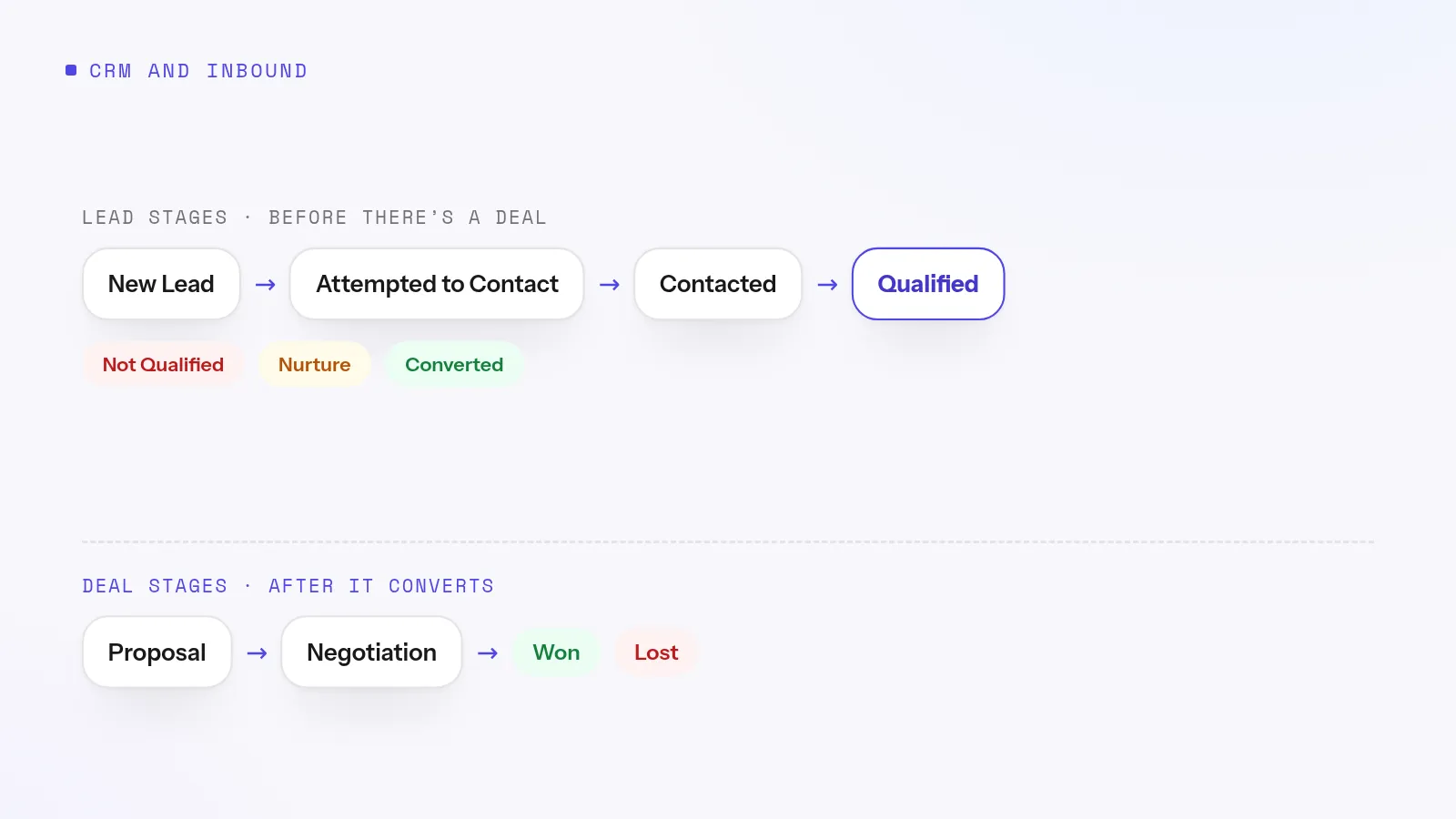
Lead stages are the steps a lead moves through before there's a deal: new, attempted, contacted, qualified, and finally converted or lost. Deal stages track the deal after that. Use one shared list of lead stages that every rep reads the same way, and keep it short enough that nobody has to guess which stage applies.
Ask five reps what "qualified" means and you'll get five answers. That's the problem lead stages solve. When every lead sits on a stage from one agreed list, a manager can see the whole funnel at a glance, reps know what to do next with each lead, and reports compare this quarter with last quarter. When the stage is a free-text column, none of that works.
11 lead status examples
Stage
What it means
Suggested rating
New Lead
Arrived, not yet called
Warm
Attempted to Contact
Called or texted, no conversation yet
Warm
Contacted
Spoke with the person at least once
Warm
Qualified
Has the need, budget and authority you sell to
Hot
Not Qualified
Doesn't fit; kept for the record
Cold
Interested
Asked for more information or a quote
Hot
Meeting Scheduled
A call, demo or visit is booked
Hot
Proposal Sent
Has a price in hand
Hot
Negotiating
Working through terms
Hot
Converted
Became a customer or a deal
None
Lost
Chose someone else or went quiet for good
None
The ratings are a starting point. A solar team might rate "Interested" warm until a site survey is booked, while an insurance team might rate it hot the moment a quote is requested.
Lead stages vs deal stages
Lead stages
Deal stages
Tracks
A person or company you might sell to
A specific opportunity with an amount
Question it answers
"Where is this lead?"
"How likely is this deal to close?"
Typical stages
New, contacted, qualified
Proposal, negotiation, closed won or lost
Measured by
Contact and conversion rates
Win probability and pipeline value
Some teams, especially those selling in one call, never need deals and work only with lead stages. Teams with longer sales cycles convert a lead into a deal once there's a real opportunity, and track it in a pipeline from then on.
Try it on your own numbers. Adoptiv puts the dialer, the phone system and the CRM in one tool. Fourteen days free, with the AI switched on.
Enough that every rep knows exactly what each one means, and few enough that they never stop to think about which to pick. For most teams, that's seven to eleven. A good test: if two stages always lead to the same next action, merge them.
Setup mistakes to avoid
Stages that describe activity, not progress. "Left voicemail" is a call outcome, not a stage.
A separate hot/warm/cold field. Reps forget to update it. Let the rating come from the stage.
Renaming by hand. If renaming a stage means editing every lead, your system is storing text, not stages.
No written definitions. Add a one-line description to every stage, and repeat it in onboarding.
How Adoptiv does it
Adoptiv's lead stages start with eleven ready-made stages: New Lead, Attempted to Contact, Contacted, Qualified, Not Qualified, Interested, Meeting Scheduled, Proposal Sent, Negotiating, Converted and Lost. Add as many of your own as you need, each with a name, color, description, place in the order and an optional hot, warm or cold rating. Because the rating belongs to the stage, moving a lead re-rates it. Rename a stage and every lead on it follows. Names are unique, so you can't end up with two Qualified stages.
Underneath, every stage rolls up to one of six fixed categories, from new and initial contact through qualification, engagement and sales process to the two outcomes. That keeps reports comparable after the list grows. Once there's a deal, it moves through pipelines whose stages each carry a win probability from 0 to 100, with separate won and lost reasons. Filter any lead list by stage and save it as a saved view.
Common questions
What are lead stages?+
The steps a lead moves through before there's a deal, such as New, Contacted, Qualified, and Converted or Lost.
What is the difference between lead status and lead stage?+
Most CRMs use the two terms for the same thing: the step a lead has reached in your process.
Are lead stages the same as pipeline stages?+
No. Lead stages track a lead before there's a deal; pipeline stages track the deal itself, usually with a win probability.
How do I mark leads hot, warm or cold?+
Give each stage a rating, so a lead's temperature changes when its stage does, with no extra field to keep up to date.
Adoptiv is the dialer, the CRM and the AI on one platform, where the busywork logs itself and your reps just talk. Try it free for 14 days, with no credit card.
Questions? Call +1 (844) 955-7733. SIYA answers and puts you through to a person.
Adoptiv Team. “Lead stages: 11 examples, and how they differ from deal stages”. Adoptiv Inc, November 12, 2026. Retrieved from https://adoptiv.com/blog/lead-stages