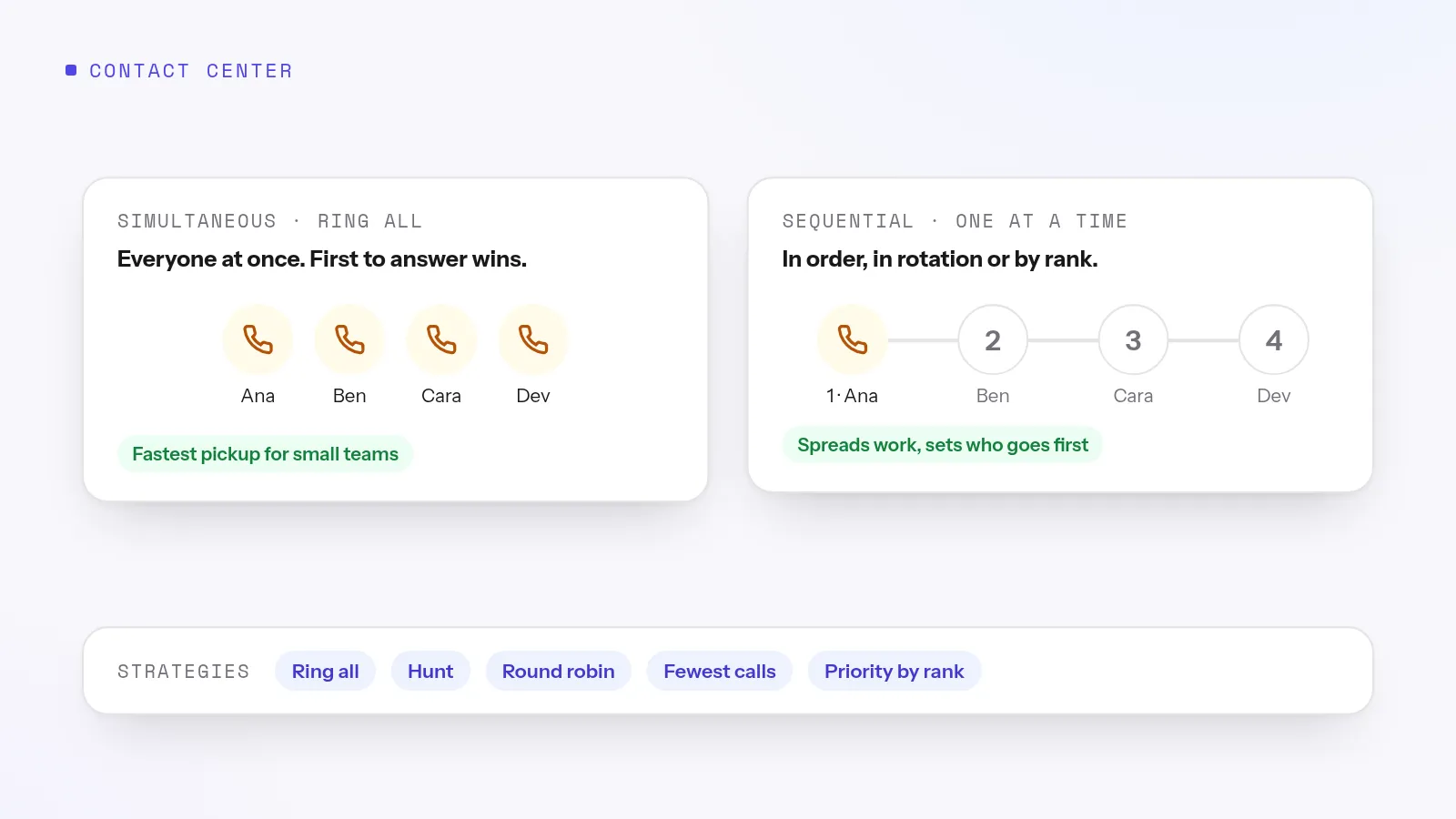
A ring strategy is the rule a phone system uses to decide who rings when a call comes in. Simultaneous ringing (ring all) rings everyone at once and the first to answer gets the call, which is fastest for small teams. Sequential ringing rings people one at a time, in a fixed order, in rotation or by rank, which spreads work and puts the right person first. Pick simultaneous for speed, sequential for fairness and control.
The same five people can feel like a great team or a chaotic one depending on how calls reach them. This post is part of our guide to contact center software, and it explains the main ring strategies and when each one fits.
Simultaneous vs sequential at a glance
Strategy
How it rings
Best for
Watch out for
Ring all (simultaneous)
Everyone at once; first to answer wins
Small teams, fast pickup
The quickest few take most calls
Hunt (sequential, fixed order)
One at a time, down the list
A clear first, second and third person
The top of the list gets every call
Round robin
One at a time, starting after whoever took the last call
Sharing calls evenly
Ignores skill and seniority
Fewest calls
Whoever has answered least rings first
Balancing workload
Counts calls, not how long they took
Priority by rank
Top rank first, then the next
Senior or specialist people first
Lower ranks may sit idle
When simultaneous ringing wins
Ring all is the right default for a small team where anyone can help and speed matters most: a front desk, a sales team taking inbound leads, a small support line. The caller waits the shortest time, because whoever is free picks up. The cost is fairness: the fastest or most eager people take most calls, and others can go a whole morning without one. On a big team, ringing everyone for every call also gets noisy.
When sequential ringing wins
Sequential strategies trade a few seconds of ringing for control. A hunt group suits a team with a clear order, such as the owner first and then an assistant. Round robin suits sales teams that want leads shared fairly; our post on round robin call distribution goes deeper. Priority suits teams where some callers need a senior person first. Fewest calls balances workload when calls vary a lot.
Try it on your own numbers. Pick one of six ring strategies on each queue, from ring all to round robin, and rank who rings first.
Two settings make any strategy work better. Ranks let you put your best people first without giving up the rest of the team as backup. Wrap-up time lets a person finish notes after a call before the next one rings. If you're still deciding whether you need a queue at all, our post on call queues vs ring groups explains the difference.
Ringing one person on several devices
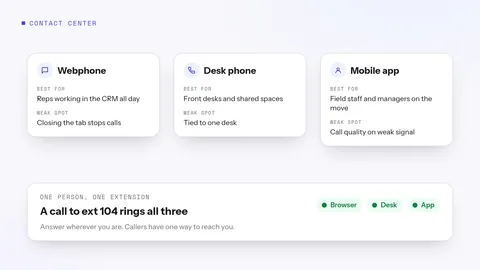
There's a second kind of simultaneous ringing: one person's call ringing their browser, mobile phone and desk phone together, so they can answer wherever they are. That's an extension setting rather than a queue strategy; our post on phone extensions for small business covers it.
Ring strategies in Adoptiv
Every call queue in Adoptiv takes one of six ring strategies: ring all, hunt, fewest calls, random, round robin and priority. Ring all is the default. Members carry a rank, so priority goes to the top rank first, and round robin starts after whoever took the last call. After a queue call, each person gets a short pause before the next queue call rings. The strategy is a setting on the queue, so you can change it without rebuilding anything.
For one person, one extension rings the browser, the Android app and a desk phone. There's no iPhone app yet.
Common questions
What is the difference between simultaneous and sequential ringing?+
Simultaneous ringing rings everyone at once and the first to answer gets the call. Sequential ringing rings people one at a time, in an order, rotation or rank.
Which ring strategy is best for a small team?+
Usually ring all, because whoever is free picks up fastest. Switch to round robin if the same people end up taking every call.
What is a hunt group?+
A group that rings members one at a time in a fixed order until someone answers.
Can I change the ring strategy later?+
In most systems, yes. In Adoptiv it's a setting on the queue, so you change it on the queue you already have.
Adoptiv is the dialer, the CRM and the AI on one platform, where the busywork logs itself and your reps just talk. Try it free for 14 days, with no credit card.
Questions? Call +1 (844) 955-7733. SIYA answers and puts you through to a person.
Adoptiv Team. “Ring strategy: simultaneous vs sequential ringing”. Adoptiv Inc, November 26, 2026. Retrieved from https://adoptiv.com/blog/ring-strategy