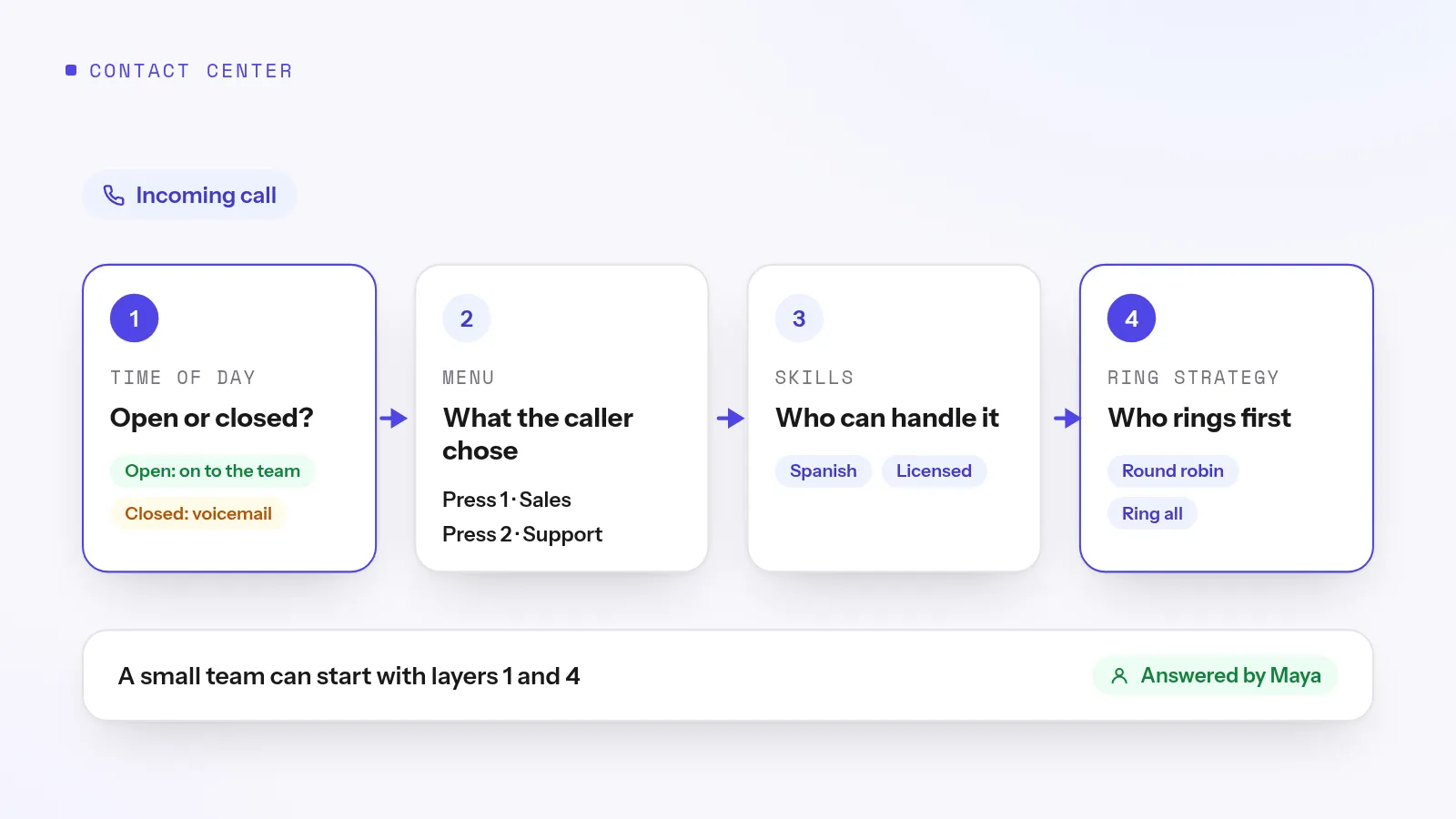
Call routing is the set of rules that decides where an incoming call goes and who answers it. Most routing combines a few layers: the time of day (open or closed), what the caller chose (a press-1 menu), who can handle it (skills or a team), and how the call is shared among the people who can (the ring strategy). Small teams usually need only the first and last layers to start.
Every business number routes calls somehow, even if the rule is "ring the owner's cell." The question is whether the rule you have still fits. This post is part of our contact center software guide.
The main types of call routing
Type
What decides it
Good for
Time-based
Business hours and holidays
Sending after-hours calls to voicemail or an answering service
Menu (IVR)
The key the caller presses
Splitting sales, support and billing
Skills-based
The skills an agent holds
Languages, products, licensed staff
Priority
Who the caller is
Moving key accounts to the front of the line
Ring strategy
The order agents are rung
Sharing calls fairly inside one team
Geographic
The caller's area code or location
Multi-location businesses
How a routed call actually flows
Picture a three-person office with one main number. A call comes in. First the system checks the time: if you're closed, it plays an after-hours message and takes a voicemail. If you're open, it plays a short greeting and offers two choices, sales or support. The caller presses 2 and lands in the support queue, where the ring strategy decides which of the three phones rings first. If nobody answers within the wait limit, the call goes where you decided in advance, usually voicemail.
That's four rules, and it covers most small businesses. Queues and ring groups are the two common ways to share calls at the last step; we compare them in call queue vs ring group.
Ring strategies: who rings first
Ring all: every phone rings at once, and the first to answer keeps the call. Fastest pickup for a small team.
Hunt: one phone at a time, in a fixed order.
Round robin: each call starts with the person after whoever took the last one, so the work rotates. More in round robin call distribution.
Fewest calls: whoever has answered the least rings first.
Priority: senior or specialist people are asked first.
Try it on your own numbers. Route every call your way with call flows, included on every plan.
Add skills when not everyone can handle every call: a Spanish-speaking line, a product only two people know, a licensed role. Add priority when some callers should never wait behind others. Both add rules to maintain, so wait until a real problem shows up. Skills-based routing covers how to set skills up without stranding calls.
A routing plan for a small team
Write down your hours and holidays, and what closed callers should hear.
Decide whether you need a menu at all. With one team, skip it.
Put the people who answer into one queue and pick a ring strategy.
Set a wait limit and decide where long waits go.
Call your own number at each hour and each menu choice before customers do.
Where Adoptiv fits
In Adoptiv you build routing in call flows, a visual builder included on every plan. A typical flow checks your business hours, plays a greeting, offers a menu and sends the call to a queue, a person or another flow. Each call queue has a wait limit, 300 seconds by default, and one of six ring strategies: ring all (the default), hunt, round robin, fewest calls, random or priority. Each ring attempt lasts 30 seconds by default.
Common questions
What is call routing?+
The rules that decide where an incoming call goes and who answers it, based on things like the time, the caller's menu choice and who is available.
What is the difference between call routing and an IVR?+
An IVR (a press-1 menu) is one kind of routing rule. Routing also covers hours, skills, priority and the order agents are rung.
Which ring strategy is best for a small team?+
Ring all usually, because the first free person picks up. Switch to round robin if the same people end up answering everything.
Do I need skills-based routing?+
Only if some calls need people with a particular skill, like a language or a license. Otherwise it adds rules without adding speed.
Adoptiv is the dialer, the CRM and the AI on one platform, where the busywork logs itself and your reps just talk. Try it free for 14 days, with no credit card.
Questions? Call +1 (844) 955-7733. SIYA answers and puts you through to a person.