Queue callbacks (virtual hold): how they work, with scripts
Adoptiv Team··3 min read
Short answer
A queue callback lets a caller who is waiting on hold press a key, hang up, and get a call back instead of holding. Their number is saved, and the team calls them back in the order they asked. It's often called virtual hold. Offer it before callers usually start hanging up, keep the offer under 15 seconds, and work the callback list oldest first.
Hold is where callers give up. Some will wait five minutes; plenty won't wait one. A callback offer turns a caller who would have hung up into a request on a list, with their number, name and the line they called, so the conversation still happens and nobody has to call in again.
How a queue callback works
The caller joins the queue and hears the welcome and hold music.
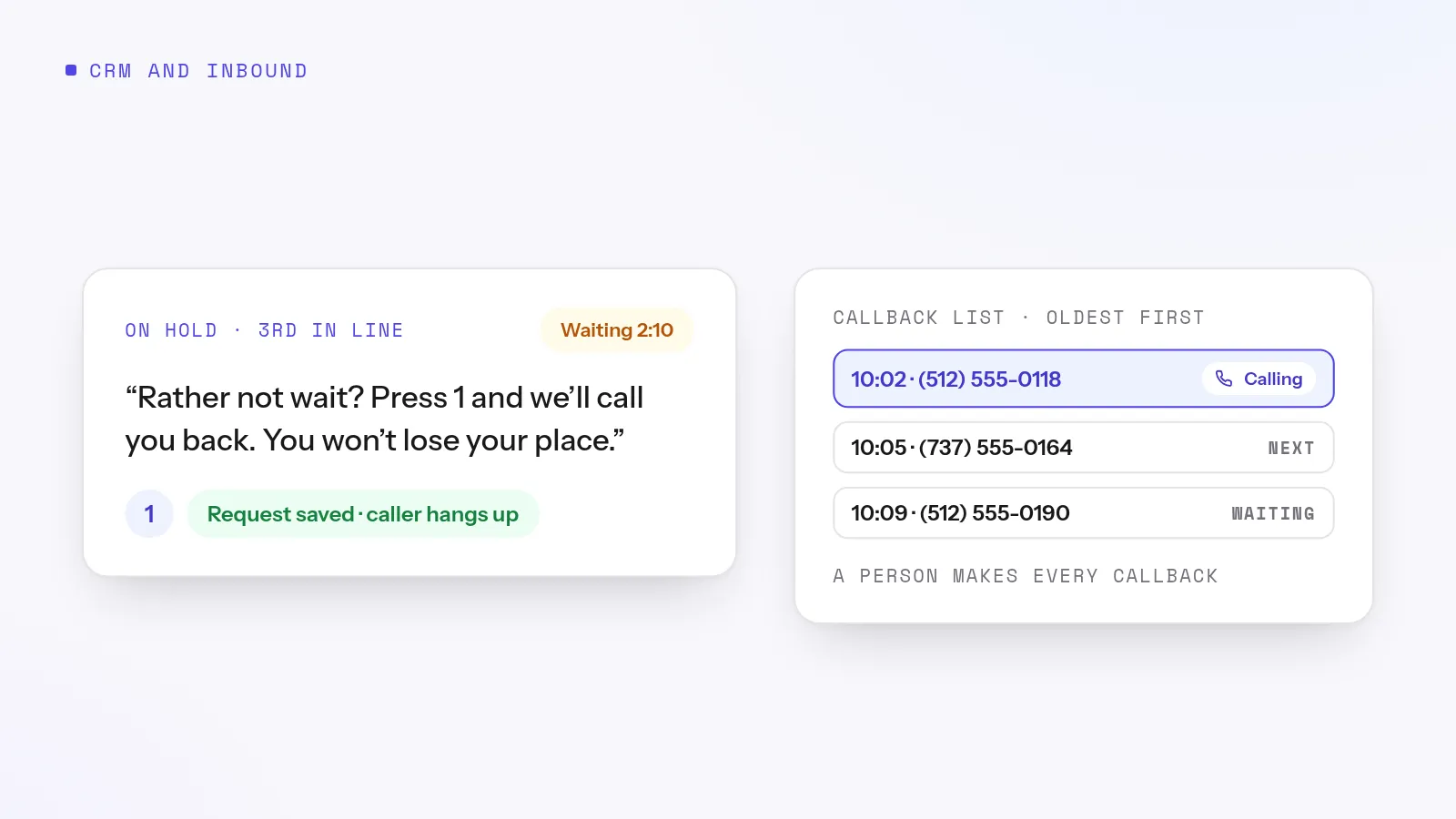
After a wait you choose, the music stops and the offer plays: "Press 1 for a call back."
The caller presses 1 and hangs up. Their request is saved. Pressing nothing keeps them on hold.
The request appears on a callback list, ordered by when they asked.
Someone on the team takes the oldest request and calls back.
Waiting on hold vs a callback
Waiting on hold
Queue callback
A long wait
Hold music until someone answers
Press a key and hang up
Hanging up
Lose your place, call again
The request stays on the list
Calling again
A new wait each time
Joins the open request
Who makes the next call
The caller
Your team
When to make the offer
Too early and you lose callers you would have answered in 30 seconds. Too late and they've already hung up. Look at your abandoned calls by how long the caller had waited: if most give up after about 90 seconds, offer the callback at about 60. On a sales line, where every missed caller costs money, offer it sooner. Some teams also offer it at a place in line, such as fifth or later, instead of after a set time.
Try it on your own numbers. Adoptiv puts the dialer, the phone system and the CRM in one tool. Fourteen days free, with the AI switched on.
Only promise what you'll keep. Don't say "within ten minutes" unless your team reliably works the list that fast.
Working the callback list
Oldest first. The request that has waited longest goes next, the order the queue would have reached them in.
Claim before calling. One person takes each request, so two reps don't call the same customer.
Merge repeats. A caller who asks twice should get one call back, not two.
Count attempts. If nobody answers, try again later and record each try. After two or three, send a text or leave a message.
One list for everything. Missed calls and voicemails are callback requests too, so they belong on the same list.
Queue callbacks in Adoptiv
Adoptiv's queue callbacks play the offer after a wait you set, or at a set place in line, on any call queue. Keys 1 and 2 accept and keep waiting unless you change them, and the offer can be an uploaded recording or typed words read as generated speech. On accept, the caller's number, name, queue and call are saved to a callback board: open requests first, then oldest first. A second request from the same number within four hours joins the open one.
Nothing dials the caller back on its own. A person claims or is assigned each request, starts the call, and can reschedule, complete or cancel it, with attempts counted. Missed calls and voicemails land on the same board, and so do callbacks booked from a call: with call outcome actions, a rep who picks a callback outcome books it in one click.
Common questions
What is virtual hold?+
Another name for a queue callback: the caller leaves the hold line, keeps their turn, and gets a call back instead of waiting.
Does the caller keep their place in line?+
Their request is ordered by when they asked, so they're called back in roughly the order the queue would have reached them.
Does Adoptiv call customers back automatically?+
No. A person on your team claims each request and makes the call, so someone always decides when the call back happens.
When should the callback offer play?+
Just before most of your callers start hanging up. Check how long abandoned callers had waited and set the offer a little earlier.
Adoptiv is the dialer, the CRM and the AI on one platform, where the busywork logs itself and your reps just talk. Try it free for 14 days, with no credit card.
Questions? Call +1 (844) 955-7733. SIYA answers and puts you through to a person.