Warm transfer vs cold transfer: when to use each, with scripts
Adoptiv Team··3 min read
Short answer
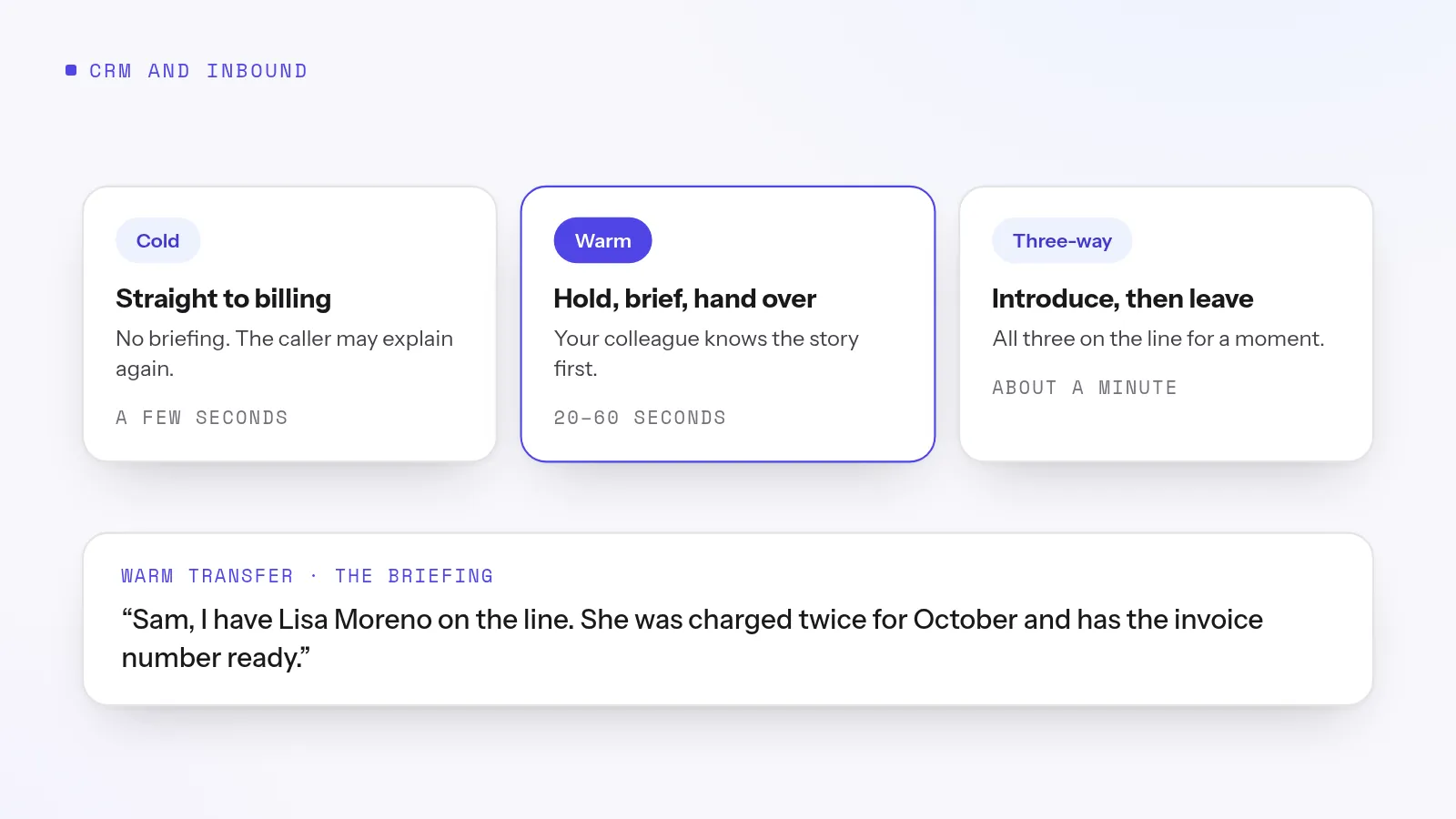
In a warm transfer you put the caller on hold, brief your colleague first, then hand the call over, so the caller doesn't repeat themselves. In a cold, or blind, transfer you send the call straight on with no conversation first. Use warm transfers when the next person needs context, such as an escalation or a qualified lead. Use cold transfers when the destination is obvious, such as billing.
Nothing annoys a caller faster than explaining their problem, being transferred, and explaining it again. Most of the time that's a cold transfer used where a warm one was needed. The fix is a simple rule for when to use each one, plus a 20-second briefing habit.
The three ways to pass a call on
Cold (blind) transfer
Warm transfer
Three-way call
What happens
The call goes straight to the next person or team
The caller holds while you brief a colleague, then you hand over
You bring a colleague onto the call, introduce them, then leave
Caller repeats themselves?
Often
No
No
Your time
A few seconds
20–60 seconds
About a minute
Best for
Billing, general questions, a known department
Escalations, complex problems, qualified leads
Handing a buyer to a closer, introductions
When to use which
Cold: the caller has a routine request, and any person in the destination can handle it. "I need a copy of my invoice."
Warm: the next person needs to know what's already been said or tried, or the caller is upset.
Three-way: the relationship matters, for example a setter handing a ready buyer to a closer, or an intake rep introducing a specialist.
Warm transfer scripts
1. Telling the caller
2. Briefing your colleague
Who, what happened, what you've already done, what they want, and their mood. Five facts, about 20 seconds.
3. Handing over
Try it on your own numbers. Adoptiv puts the dialer, the phone system and the CRM in one tool. Fourteen days free, with the AI switched on.
Only promise what the destination will actually do. If a queue sends unanswered callers to voicemail, say so.
Tips that make transfers work
Never transfer without telling the caller where they're going and why.
If your colleague can't take it, come back to the caller and offer a callback rather than leaving them on hold.
Write a one-line note on the record before you hand over, so it's there even if the call drops.
Keep the recording in one piece, so a supervisor reviewing it hears the whole conversation.
Transfers in Adoptiv
Adoptiv's call transfer covers all three from the call bar. A warm transfer puts the caller on hold with music while a second line rings a colleague's extension or an outside number. Your conversation is private and gets its own call record, linked to the original. A cold transfer can go to a person, team, role, call queue, IVR menu, voicemail box or outside number. It doesn't come back to you; if nobody answers, the destination's own fallback runs. A three-way call adds one extra party, and you can drop your own line and leave the other two talking.
The call recording carries on as one file through every transfer and three-way call. Adoptiv doesn't play a recording announcement, so add your own notice where your calls need one. This is general information, not legal advice.
Common questions
What is a warm transfer?+
A transfer where you speak to the next person before handing the call over, so the caller doesn't have to explain their problem again.
Is a blind transfer the same as a cold transfer?+
Yes. Both mean sending the call straight on without speaking to the next person first.
How long should a warm transfer take?+
Aim for under a minute of hold. A good briefing covers who is calling, what happened, what you've done, and what they want in about 20 seconds.
Can I warm transfer to a queue?+
In Adoptiv, no. Warm transfers go to a colleague's extension or an outside number. Queues, teams and menus take cold transfers.
Adoptiv is the dialer, the CRM and the AI on one platform, where the busywork logs itself and your reps just talk. Try it free for 14 days, with no credit card.
Questions? Call +1 (844) 955-7733. SIYA answers and puts you through to a person.